Abundant Health

Up to date health information tailored for you

  • Home
  • Blog
  • Recipes
  • Shop
  • Contact
You are here: Home / Archives for Emma Beckett

Emma Beckett

Stop Hating on Pasta

September 10, 2023 by Emma Beckett - [rt_reading_time label="Reading Time:" postfix="minutes" postfix_singular="minute"]

Stop Hating on Pasta

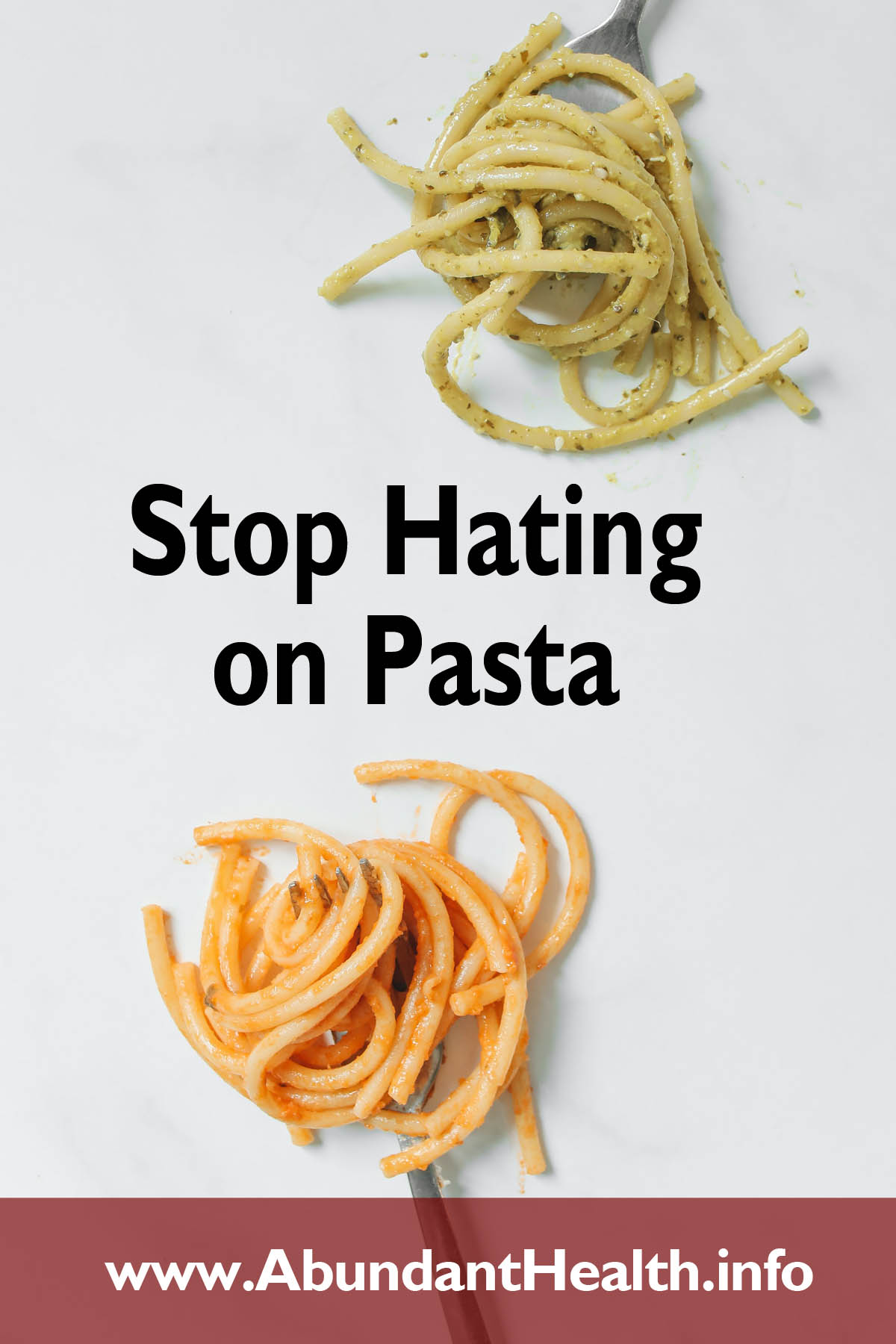
New year, new you, new diet. It’s a familiar refrain. One popular dieting technique is to create a food blacklist. Quitting “carbs” or packaged foods is common, which can mean avoiding supermarket staples like pasta. But do we really need to ban pasta to improve our diets?
Stop Hating on Pasta

This is what we call a reductionist approach to nutrition, where we describe a food based on just one of its key components. Pasta isn’t just carbohydrates. One cup (about 145 grams) of cooked pasta has about 38g of carbohydrates, 7.7g of protein and 0.6g of fats. Plus, there’s all the water that is absorbed from cooking and lots of vitamins and minerals.((Pasta, white wheat flour, boiled from dry, no added salt. Food Standards Australia & NZ))

“But pasta is mostly carbs!” I hear you cry. This is true, but it’s not the whole story. We need to think about context.

Your day on a plate

You probably know there are recommendations for how much energy (kilojoules or calories) we should eat in a day.((Nutrient Reference Values. eatforhealth.gov.au)) These recommendations are based on body size, sex and physical activity. But you might not realise there are also recommendations about the profile of macronutrients – or types of food – that supply this energy.

Fats, carbs and proteins are macronutrients. Macronutrients are broken down in the body to produce energy for our bodies.

Acceptable Macronutrient Distribution Ranges describe the ratio or percentage of macronutrients that should provide this energy.((Nutrient Reference Values. eatforhealth.gov.au)) These ranges are set by experts based on health outcomes and models of healthy eating. They aim to make sure we get enough, but not too much, of each macro. Consuming too much or too little of any type of food can have consequences for health.

The ratios are also designed to make sure we get enough of the vitamins and minerals that come with the energy in the foods we typically eat. We should get 45–65% of our energy from carbohydrates, 10–30% from proteins, and 20–35% from fats.

Mangia pasta

Macronutrient ratios mean it can be healthy to eat up to between 1.2 and 6.5 times more carbohydrates in a day than protein – since each gram of protein has the same amount of energy as a gram of carbohydrates.

The ratio of carbs to protein in pasta is 38g to 7.7g, which equates to roughly a 5:1 ratio, well within the acceptable macronutrient distribution range. Meaning pasta actually has enough protein to balance with the carbohydrates. This isn’t just because of the eggs in pasta either. Wheat is another source of protein, making up about 20% of the proteins eaten globally.((Erenstein, O., Jaleta, M., Mottaleb, K.A., Sonder, K., Donovan, J., Braun, HJ. (2022). Global Trends in Wheat Production, Consumption and Trade. In: Reynolds, M.P., Braun, HJ. (eds) Wheat Improvement. Springer, Cham. https://doi.org/10.1007/978-3-030-90673-3_4))

If you are worried about the calorie levels and weight gain, that’s not so simple either.

In the context of an otherwise healthy diet, people have been shown to lose more weight when their diet includes pasta regularly.((Chiavaroli L, Kendall CWC, Braunstein CR, et al. Effect of pasta in the context of low-glycaemic index dietary patterns on body weight and markers of adiposity: a systematic review and meta-analysis of randomised controlled trials in adults. BMJ Open 2018;8:e019438. doi: 10.1136/bmjopen-2017-019438))

And, a systematic review of ten different studies found pasta was better for post-meal blood glucose levels than bread or potatoes.((M. Huang, J. Li, M.-A. Ha, G. Riccardi, S. Liu, A systematic review on the relations between pasta consumption and cardio-metabolic risk factors, Nutrition, Metabolism and Cardiovascular Diseases, Volume 27, Issue 11, 2017, Pages 939-948, ISSN 0939-4753,
https://doi.org/10.1016/j.numecd.2017.07.005))
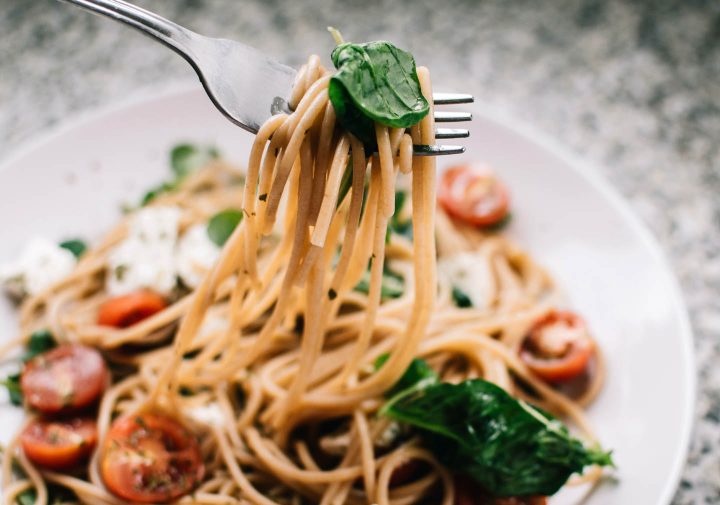
Pasta with basil and cherry tomatoes

Instead of quitting spaghetti, consider reducing portion sizes, or switching to wholegrain pasta, which has a higher fibre content which has benefits for gut health and can help you feel fuller longer.((Iolanda Cioffi et.al. Effects on satiation, satiety and food intake of wholegrain and refined grain pasta, Appetite, Volume 107, 2016, Pages 152-158, ISSN 0195-6663, https://doi.org/10.1016/j.appet.2016.08.002))

Gluten-free pasta has slightly less protein than wheat pasta. So, despite being healthier for people with gluten intolerance, there are no increased health benefits in switching to gluten-free pasta for most of us.((Pasta, gluten free. nutritionvalue.org))

Pass the pesto and the leftover bolognese

Pasta is also not typically eaten alone. So, while some warn about the dangers of blood sugar spikes when eating “naked carbs” (meaning just carbs with no other foods), this typically isn’t a risk for pasta.((Dressing Up Naked Carbs To Make More Filling Meals and Snacks. loseitblog.com))

When pasta provides the base of a meal, it can be a vehicle to help people eat more vegetables in smooth or chunky vegetable sauces. For kids (or fussy adults) pasta sauce can be a great place to hide pureed or grated vegetables.((Pasta with tomato & hidden veg sauce. BBC Good Food))

Not eating pasta alone is also important for the protein profile. Plant foods are typically not complete proteins, which means we need to eat combinations of them to get all the different types of amino acids (the building blocks of proteins) we need to survive.((Are ‘Incomplete’ Proteins a Myth? healthline.com))

But pasta, even though we often focus on the carbs and energy, packs a good nutritional punch. Like most foods, it isn’t just macronutrients it also has micronutrients.

One cup of cooked pasta has about a quarter of our daily recommended intakes of vitamins B1 and B9, half the recommended intake of selenium, and 10% of our iron needs.((Pasta, white wheat flour, boiled from dry, no added salt. Food Standards Australia & NZ))

The news for pasta gets even better when we eat it as leftovers. When pasta is cooked and cooled, some of the carbohydrates convert to resistant starch.((Canas S et.al. Effect of cooking, 24 h cold storage, microwave reheating, and particle size on in vitro starch digestibility of dry and fresh pasta. https://doi.org/10.1039/D0FO00849D)) This starch gets its name from being resistant to digestion, so it contributes less energy and is better for blood sugar levels.((Hodges C, Archer F, Chowdhury M, Evans BL, Ghelani DJ, Mortoglou M, Guppy FM. Method of Food Preparation Influences Blood Glucose Response to a High-Carbohydrate Meal: A Randomised Cross-over Trial. Foods. 2019 Dec 25;9(1):23. doi: 10.3390/foods9010023)) So, your leftover pasta, even if you reheat it, is lower in calories than the night before.

Look a little closer at ‘carb’ choices

There is a lot of talk about reducing intakes of carbohydrates for weight loss, but remember carbs come in different forms and in different foods.

Some of them, like pasta, bring other benefits. Others like cakes and lollies, add very little else. When we talk about reducing intake of refined carbohydrates, think first of sweets that are eaten alone, before you cut the staple carbohydrates that are often served with vegetables – arguably the healthiest core food group!
Healthy Fruits

Stay Always Up to Date

Sign up to our newsletter and stay always informed with news and tips around your health.

Sign Up Now!

This article is republished from The Conversation under a Creative Commons license. Read the original article.

The Conversation

Filed Under: Nutrition Tagged With: healthy carbs, pasta

Caffeine Makes You Borrow Energy, But You Pay The Bill

May 14, 2023 by Emma Beckett - [rt_reading_time label="Reading Time:" postfix="minutes" postfix_singular="minute"]

Caffeine Makes You Borrow Energy, But You Pay The Bill

Many of us want (or should I say need?) our morning coffee to give us our “get up and go”. Altogether, the people of the world drink more than two billion cups of coffee each day.((Surma, S., Oparil, S. Coffee and Arterial Hypertension. Curr Hypertens Rep 23, 38 (2021). https://doi.org/10.1007/s11906-021-01156-3)) You might think coffee gives you the energy to get through the morning or the day – but coffee might not be giving you as much as you think.

Caffeine Makes You Borrow Energy, But You Pay The Bill

The main stimulant in coffee is the caffeine. And the main way caffeine works is by changing the way the cells in our brain interact with a compound called adenosine.((Timothy Roehrs, Thomas Roth, Caffeine: Sleep and daytime sleepiness, Sleep Medicine Reviews, Volume 12, Issue 2, 2008, Pages 153-162, https://doi.org/10.1016/j.smrv.2007.07.004.))

Getting busy, getting tired

Adenosine is part of the system that regulates our sleep and wake cycle and part of why high levels of activity lead to tiredness.((Tarja Porkka-Heiskanen, Lauri Alanko, Anna Kalinchuk, Dag Stenberg, Adenosine and sleep, Sleep Medicine Reviews, Volume 6, Issue 4, 2002, Pages 321-332, ISSN 1087-0792, https://doi.org/10.1053/smrv.2001.0201.)) As we go about our days and do things, levels of adenosine rise because it is released as a by-product as energy is used in our cells.((Huang Z et.al. The Role of Adenosine in the Regulation of Sleep. https://doi.org/10.2174/156802611795347654))

Eventually adenosine binds to its receptor (parts of cells that receive signals) which tells the cells to slow down, making us feel drowsy and sleepy. This is why you feel tired after a big day of activity. While we are sleeping, energy use drops lowering adenosine levels as it gets shuffled back into other forms.((Bjorness T et.al. Adenosine and Sleep. https://doi.org/10.2174/157015909789152182)) You wake up in the morning feeling refreshed. Well, if you get enough sleep that is.

If you are still feeling drowsy when you wake up caffeine can help, for a while. It works by binding to the adenosine receptor, which it can do because it is a similar shape.((Fredholm B. Adenosine, Adenosine Receptors and the Actions of Caffeine. https://doi.org/10.1111/j.1600-0773.1995.tb00111.x)) But it is not so similar that it triggers the drowsy slow-down signal like adenosine does. Instead it just fills the spots and stops the adenosine from binding there. This is what staves off the drowsy feeling.

No free ride

But there is a catch. While it feels energising, this little caffeine intervention is more a loan of the awake feeling, rather than a creation of any new energy.

This is because the caffeine won’t bind forever, and the adenosine that it blocks doesn’t go away. So eventually the caffeine breaks down, lets go of the receptors and all that adenosine that has been waiting and building up latches on and the drowsy feeling comes back – sometimes all at once.

So, the debt you owe the caffeine always eventually needs to be repaid, and the only real way to repay it is to sleep.

A woman sleeping

Timing is everything

How much free adenosine is in your system, that hasn’t attached to receptors yet, and how drowsy you are as a consequence will impact how much the caffeine you drink wakes you up. So, the coffee you drink later in the day, when you have more drowsy signals your system may feel more powerful.((Smith A. P. The effects of caffeine, impulsivity and time of day on performance, mood and cardiovascular function. https://doi.org/10.1177/026988119100500205))

If it’s too late in the day, caffeine can make it hard to fall asleep at bedtime. The “half life” of caffeine (how long it takes to break down half of it) is about five hours.((Caffeine for the Sustainment of Mental Task Performance. Formulations for Military Operations. Chapter 2. National Academies, 2001)) That said, we all metabolise caffeine differently, so for some of us the effects wear off more quickly.((Nehlig A. Interindividual Differences in Caffeine Metabolism and Factors Driving Caffeine Consumption. Pharmacol Rev. 2018 Apr;70(2):384-411. doi: 10.1124/pr.117.014407)) Regular coffee drinkers might feel less of a caffeine “punch”, with tolerance to the stimulant building up over time.((Ammon HP. Biochemical mechanism of caffeine tolerance. Arch Pharm (Weinheim). 1991 May;324(5):261-7. doi: 10.1002/ardp.19913240502.))

Caffeine can also raise levels of cortisol, a stress hormone that can make you feel more alert.((Lovallo WR, Whitsett TL, al’Absi M, Sung BH, Vincent AS, Wilson MF. Caffeine stimulation of cortisol secretion across the waking hours in relation to caffeine intake levels. Psychosom Med. 2005 Sep-Oct;67(5):734-9. doi: 10.1097/01.psy.0000181270.20036.06.)) This might mean caffeine feels more effective later in the morning, because you already have a natural rise in cortisol when you wake up. The impact of a coffee right out of bed might not seem as powerful for this reason.

If your caffeinated beverage of choice is also a sugary one, this can exacerbate the peak and crash feeling. Because while sugar does create actual energy in the body, the free sugars in your drink can cause a spike in blood sugar, which can then make you feel tired when the dip comes afterwards.

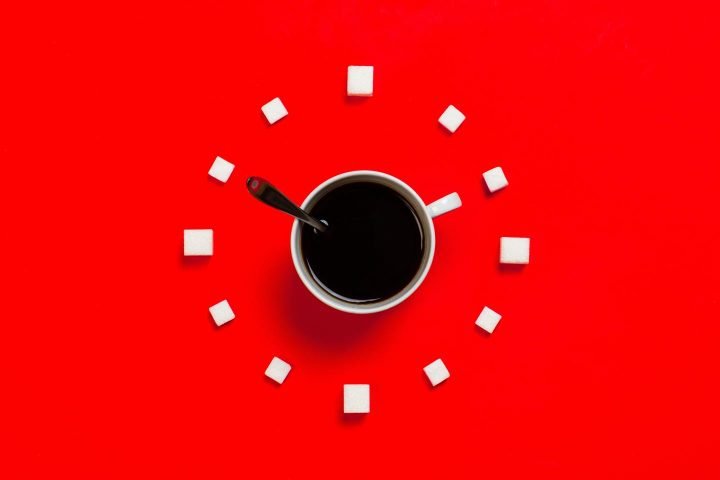
A clock symbolized by a coffee cup and sugarcubes.

While there is no proven harm of drinking coffee on an empty stomach, coffee with or after a meal might hit you more slowly. This is because the food might slow down the rate at which the caffeine is absorbed.((Caffeine. The Nutrition Source. Harvard School of Public Health))

What about a strong tea or fizzy cola?

Coffee, of course, isn’t the only caffeinated beverage that can loan you some energy.

The caffeine in tea, energy drinks and other beverages still impacts the body in the same way. But, since the ingredients mostly come from plants, each caffeinated beverage has its own profile of additional compounds which can have their own stimulant effect, or can interact with caffeine to change its impacts.((Barbara Penolazzi, Vincenzo Natale, Luigi Leone, Paolo Maria Russo, Individual differences affecting caffeine intake. Analysis of consumption behaviours for different times of day and caffeine sources, Appetite, Volume 58, Issue 3, 2012, Pages 971-977, ISSN 0195-6663, https://doi.org/10.1016/j.appet.2012.02.001.))

Caffeine isn’t magic. To create energy and re-energise our bodies we need enough food, water and sleep.


For more information on the negative impacts of caffeine, continue with this article:
What Caffeine is doing to You and Your Child?

Healthy Fruits

Stay Always Up to Date

Sign up to our newsletter and stay always informed with news and tips around your health.

Sign Up Now!

This article is republished from The Conversation under a Creative Commons license. Read the original article.
The Conversation

Filed Under: Healthy Lifestyle, Temperance

Primary Sidebar

Social Channels

Coronavirus Immunity Challenge

Boost your immune system to be bullet-proof for the pandemic.

I Want to Participate

Recent Posts

  • 5 Habits to Live Longer
  • Better Sleep Can Protect Against Dementia
  • Finding Peace In Your Crazy-Busy World
  • Flaxseed – An Ancient Plant Rediscovered
  • Platelets – Triggers for Life or Death
  • Boderline Personality Disorder
  • In Praise of Almonds and Nuts
  • Are You Stuck in the Clutter Trap?

Categories

  • Body Systems (16)
    • Cell Function (2)
    • Circulatory System (1)
    • Digestive Tract (10)
    • Immune System (4)
  • Diseases (27)
    • Cancer (2)
    • Cold (1)
    • COVID-19 (11)
    • Dementia (1)
    • Diabetes (1)
    • Digestive Diseases (2)
    • Heart Disease (2)
    • Kidneys (1)
    • Metabolic Syndrome (2)
    • Skin (1)
  • Healthy Lifestyle (42)
    • Exercise (11)
    • Gardening (2)
    • Sleep (7)
    • Sunlight (2)
    • Temperance (14)
    • Water (4)
  • Mental Health (87)
    • Addictions (6)
    • Anxiety (7)
    • Burnout (1)
    • Depression (7)
    • Psychosomatic Diseases (6)
    • Stress Management (45)
    • Trust (6)
  • Nutrition (56)
  • Obesity (9)
  • Phases of Life (14)
    • Adults (3)
    • Babies and Infants (1)
    • Children (3)
    • Seniors (5)
    • Teenagers (3)
  • Therapies (7)
    • Herbs (5)
    • Hydrotherapy (1)
  • Uncategorized (3)

Archives

  • January 2025 (1)
  • March 2024 (5)
  • February 2024 (4)
  • January 2024 (4)
  • December 2023 (5)
  • November 2023 (4)
  • October 2023 (5)
  • September 2023 (4)
  • August 2023 (3)
  • July 2023 (2)
  • June 2023 (4)
  • May 2023 (4)
  • April 2023 (5)
  • March 2023 (4)
  • February 2023 (4)
  • January 2023 (4)
  • December 2022 (4)
  • November 2022 (4)
  • October 2022 (5)
  • September 2022 (4)
  • August 2022 (4)
  • July 2022 (5)
  • June 2022 (4)
  • May 2022 (5)
  • April 2022 (4)
  • March 2022 (4)
  • February 2022 (4)
  • January 2022 (5)
  • December 2021 (3)
  • November 2021 (4)
  • October 2021 (6)
  • September 2021 (4)
  • August 2021 (4)
  • July 2021 (5)
  • June 2021 (4)
  • May 2021 (3)
  • April 2021 (5)
  • March 2021 (4)
  • February 2021 (4)
  • January 2021 (5)
  • December 2020 (3)
  • November 2020 (4)
  • October 2020 (5)
  • September 2020 (5)
  • August 2020 (3)
  • July 2020 (1)
  • June 2020 (1)
  • May 2020 (1)
  • April 2020 (1)
  • March 2020 (1)

Copyright © 2026 · Abundant Health - Privacy Policy - Medical Disclaimer