Abundant Health

Up to date health information tailored for you

  • Home
  • Blog
  • Recipes
  • Shop
  • Contact
You are here: Home / Archives for Uncategorized

Uncategorized

5 Habits to Live Longer

January 5, 2025 by Martin Neumann - [rt_reading_time label="Reading Time:" postfix="minutes" postfix_singular="minute"]

At this time of year many of us resolve to prioritise our health. So it is no surprise there’s a roaring trade of products purporting to guarantee you live longer, be healthier and look more youthful.

While an estimated 25% of longevity is determined by our genes, the rest is determined by what we do, day to day.

There are no quick fixes or short cuts to living longer and healthier lives, but the science is clear on the key principles. Here are five things you can do to extend your lifespan and improve your health.

1. Eat a predominantly plant-based diet

What you eat has a huge impact on your health. The evidence overwhelmingly shows eating a diet high in plant-based foods is associated with health and longevity.

If you eat more plant-based foods and less meat, processed foods, sugar and salt, you reduce your risk of a range of illnesses that shorten our lives, including heart disease and cancer.

Plant-based foods are rich in nutrients, phytochemicals, antioxidants and fibre. They’re also anti-inflammatory. All of this protects against damage to our cells as we age, which helps prevent disease.

No particular diet is right for everyone but one of the most studied and healthiest is the Mediterranean diet. It’s based on the eating patterns of people who live in countries around the Mediterranean Sea and emphases vegetables, fruits, wholegrains, legumes, nuts and seeds, fish and seafood, and olive oil.

2. Aim for a healthy weight

Another important way you can be healthier is to try and achieve a healthy weight, as obesity increases the risk of a number of health problems that shorten our lives.

Obesity puts strain on all of our body systems and has a whole myriad of physiological effects including causing inflammation and hormonal disturbances. These increase your chances of a number of diseases, including heart disease, stroke, high blood pressure, diabetes and a number of cancers.

In addition to affecting us physically, obesity is also associated with poorer psychological health. It’s linked to depression, low self-esteem and stress.

One of the biggest challenges we face in the developed world is that we live in an environment that promotes obesity. The ubiquitous marketing and the easy availability of high-calorie foods our bodies are hard-wired to crave mean it’s easy to consume too many calories.

3. Exercise regularly

We all know that exercise is good for us – the most common resolution we make this time of year is to do more exercise and to get fitter. Regular exercise protects against chronic illness, lowers your stress and improves your mental health.

While one of the ways exercising helps you is by supporting you to control your weight and lowering your body fat levels, the effects are broader and include improving your glucose (blood sugar) use, lowering your blood pressure, reducing inflammation and improving blood flow and heart function.

While it’s easy to get caught up in all of the hype about different exercise strategies, the evidence suggests that any way you can include physical activity in your day has health benefits. You don’t have to run marathons or go to the gym for hours every day. Build movement into your day in any way that you can and do things that you enjoy.

4. Don’t smoke

If you want to be healthier and live longer then don’t smoke or vape.

Smoking cigarettes affects almost every organ in the body and is associated with both a shorter and lower quality of life. There is no safe level of smoking – every cigarette increases your chances of developing a range of cancers, heart disease and diabetes.

Even if you have been smoking for years, by giving up smoking at any age you can experience health benefits almost immediately, and you can reverse many of the harmful effects of smoking.

If you’re thinking of switching to vapes as a healthy long term option, think again. The long term health effects of vaping are not fully understood and they come with their own health risks.

5. Prioritise social connection

When we talk about living healthier and longer, we tend to focus on what we do to our physical bodies. But one of the most important discoveries over the past decade has been the recognition of the importance of spiritual and psychological health.

People who are lonely and socially isolated have a much higher risk of dying early and are more likely to suffer from heart disease, stroke, dementia as well as anxiety and depression.

Although we don’t fully understand the mechanisms, it’s likely due to both behavioural and biological factors. While people who are more socially connected are more likely to engage in healthy behaviours, there also seems to be a more direct physiological effect of loneliness on the body.

So if you want to be healthier and live longer, build and maintain your connections to others.

Healthy Fruits

Stay Always Up to Date

Sign up to our newsletter and stay always informed with news and tips around your health.

Sign Up Now!

This article is republished from The Conversation under a Creative Commons license. Read the original article.


Filed Under: Uncategorized

Give up Illusions and Dreams

December 31, 2023 by Dr. Cesar Vasconcellos de Souza - [rt_reading_time label="Reading Time:" postfix="minutes" postfix_singular="minute"]

Give up Illusions and Dreams

Today we are going to examine the consequences of our illusions. Often, we find it difficult to accept reality because of our aspirations. Even if we have healthy and ethical desires, we don’t always achieve many of them in this life. In addition, we often have to give up pursuing these desires, even if they are good ones, for various reasons. It is not without reason that Jesus Christ said that those who want to follow him and serve him must die to self, take up their cross, lose their lives, and this, one day at a time.

Give up Illusions and Dreams

Jesus explained:

Whoever loses his life for my sake will find it.

Matthew 16:25

Losing your life can mean giving up the pursuit of some dream, so that God’s will be done in your life, and this is not easy for anyone. However, in surrendering our desire, when you understand what God really wants from you, it becomes possible to liberate our self to pursue a life of service that gives meaning to our existence.

Much of the anxiety, sadness, anger, and frustration at unfulfilled desires can be alleviated when we die to self, to our desires, leaving the consequences in the hands of the Creator of the universe. It is a paradox that you die in order to live. Nature teaches us that the seed needs to be buried in the earth in order to grow into a mature plant that produces fruit.

Pflanzen - Energie für unser Leben

Many of our mental sufferings can be rooted in illusions, desires, and attachments. God never requires anything from us without giving us something better in return, even if it involves a loss of material goods, fame, or social power. Living on illusions and desires can hold us back. Giving up our own desires for God’s sake brings relief. This doesn’t mean that we’ll be left empty-handed and have a sad or mediocre life. On the contrary, we become enthusiastic when we surrender to God. Did you know that the meaning of the word enthusiasm is to be full of God? Enthusiasm means being filled with God.

Jesus’ recommendation in the Gospels, in this context of our dreams and personal desires, is to die to self, to live with joy and unselfish attitudes produced by the influence of the Holy Spirit. People who are very controlling live in the illusion of control. This produces a lot of stress because so many things are beyond our control. But thinking we do, we continue in the illusion, wearing ourselves out needlessly.

For example, we can’t control people’s attitudes, what they think, what they feel, what they do. People will do what they want, not what we want, because we have no control over them. The more you try to control someone, the more tension and stress will arise within yourself and in that relationship that you actuate, craving control.

A man trying to control another person

The most corrupt people live under the illusion that acquiring material goods in an illicit way will make them happy. It is an illusion to seek happiness in deceit and fraud. It is impossible to obtain inner peace in this way. You can even acquire considerable social and economic power, but I’ve treated numerous famous, wealthy people who have become depressed, addicted to drugs, suffering from difficult to treat insomnia, exaggerated fears, excessive anxiety, and some have even committed suicide, because they lived in the illusion of happiness based on material wealth, fame and social power.

When we see that control is an illusion, we can finally let go and surrender to God and let Him control our lives. This is the path to relief, serenity and mental health. And it’s not a passive attitude of doing nothing and crossing our arms. There will be plenty to be done, just now under the influence of God’s Spirit and no longer under the control of a complicated self.

Some of us, sincerely and unconsciously, try to fill a sense of loneliness and emptiness that we feel even with many people around us, through the illusion of solving it with something outside of ourselves, be it material wealth or a romantic passion, for example. It’s not uncommon for people to become compulsive shoppers, addicted to drugs, alcohol, sex, passion, the acquisition of social, economic and political power, addicted to food, to gambling, in an unconscious attempt, most of the time, to fill this mental void.

However, there is only one effective way for our lives to have meaning, producing serenity and noble purpose: it is the search for spiritual strength, the daily victory over our character defects, and the search for an attitude of service without conflicts of interest. Think about it and avoid looking in places, in people, in philosophies, ideologies, and objects to find peace and meaning in life, which is only found in goodness, justice, and truth.

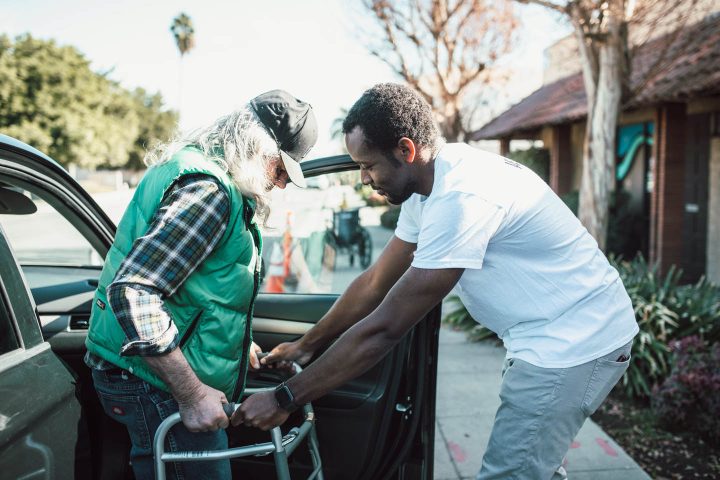
Helping a man getting out of the car with a walker

The way out of our deep emotional pain, emptiness, and spiritual need does not lie in economic power, in the illusion of control over others and reality, or in drugs. It doesn’t lie in acquiring fame or any kind of power, except spiritual power, which is obtained as Jesus Christ said, by surrendering everything to Him, dying to self, losing your life in gratitude and love for what He has done, and does for those who believe in Him and surrender to Jesus unconditionally.

Give up the illusion of control; place that burden on God, the Creator of the universe. Let Him fulfill your dreams in the way, manner, and time that He sees fit. You can’t have mental maturity without spiritual health. Pray to God, the Creator of the universe, open your heart to Him, and search the Holy Scriptures for the truth, for the way God indicates how you can have goodness, justice and truth within you, which is a healing process, a miraculous divine therapy that comes to us from above. We can’t produce this in ourselves. May God help us to surrender to Him one day at a time, in the faith that by doing so, He will take over our lives, and then we will have enthusiasm, being filled with God.

Healthy Fruits

Stay Always Up to Date

Sign up to our newsletter and stay always informed with news and tips around your health.

Sign Up Now!

Filed Under: Mental Health, Trust, Uncategorized Tagged With: surrender

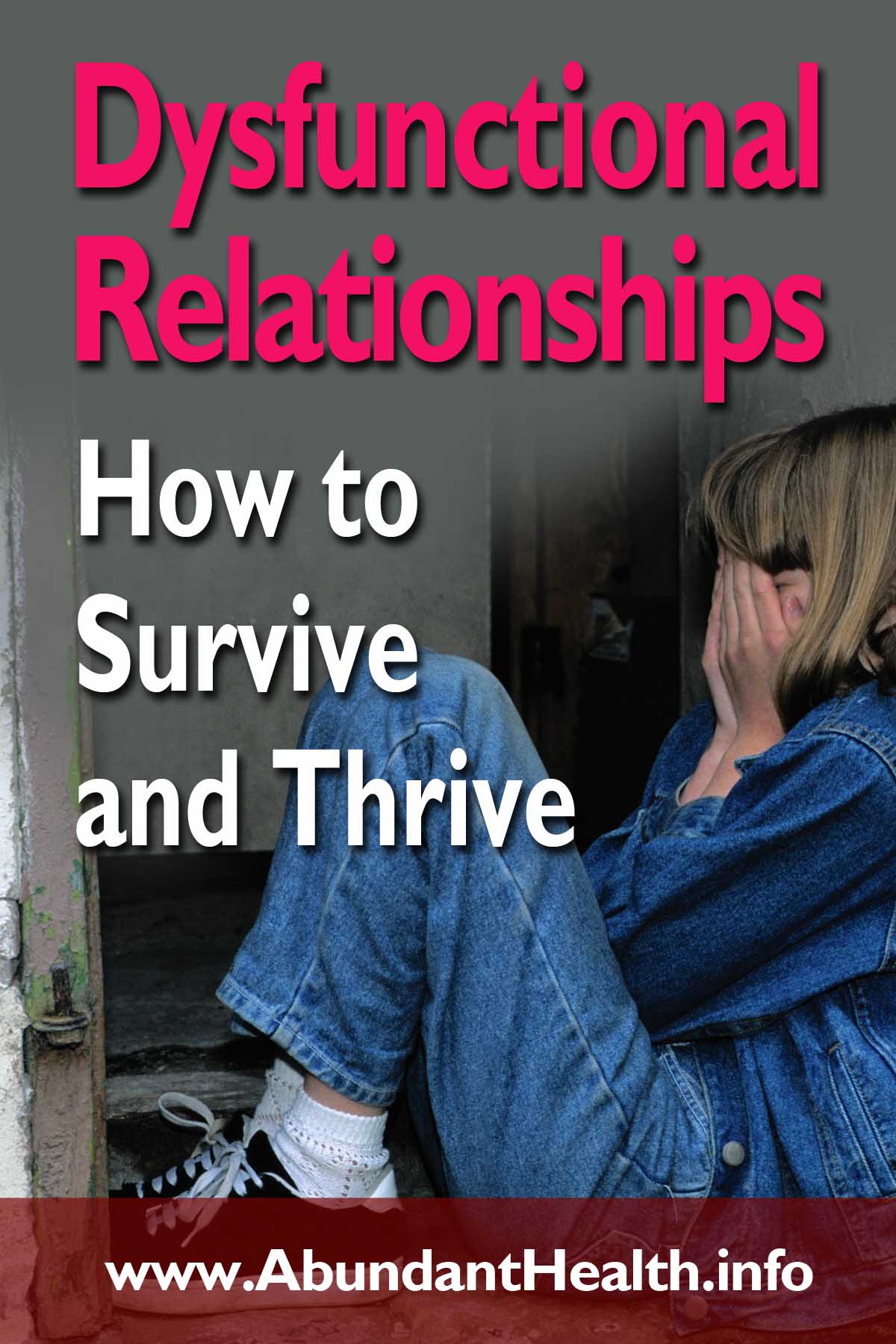
Dysfunctional Relationships – How to Survive and Thrive

October 24, 2021 by Elizabeth Hall - [rt_reading_time label="Reading Time:" postfix="minutes" postfix_singular="minute"]

Dysfunctional Relationships

The simplest meaning of “dysfunctional” is “doesn’t work right.” Dysfunction comes in differing degrees. Some dysfunctional things or people grate on one’s nerves just a little bit—like a squeaky door. But when a situation involves people who must relate to each other or when circumstances are perceived as intolerable, you must do one of two things. You can modify this situation—at least partially—or remove yourself. For example, when a dysfunctional organ or system of your body results in disease, you had better see a doctor sooner rather than later if you want to survive.

Dysfunctional Relationships - How to Survive and Thrive

When families become dysfunctional, society becomes dysfunctional because the family is society’s foundational unit. Alcohol, drug abuse, “workaholism,” mental illness, parental neglect, indifference, abandonment, or the untimely death of a family member can contribute to personal dysfunction and dysfunctional group behavior. Even a physical disease like congestive heart failure can become so severe that significant cognitive impairment, cantankerous attitudes, and impaired interpersonal relationships result, all because the blood vessels supplying the brain are not receiving sufficient blood and oxygen for its needs.

Like a genetic disease, dysfunction is frequently passed on, in some form, from generation to generation. Its ripples can affect society in social costs, affecting non-familial relations. They sap our energy and resources, as would a chronic disease. The extent to which a specific family dysfunction influences us depends upon the degree, timing, and context in which we received the abuse, injustice, or injury, and our coping capacities.

Dysfunction Does Not Mean You Cannot Be Great!

When Eleanor Roosevelt was born, her gorgeous socialite mother, Anna, marveled that she could have produced such a homely child. “She was a sensitive, timid child, and from her earliest years, Eleanor knew she was a disappointment to her mother, who would look at Eleanor rather coldly, worrying that her daughter might never become beautiful. She would even discuss it in the presence of Eleanor and her friends. Even as an adult, memories of her mother’s attitude haunted her—echoing the painful realization, ‘I’m ugly.’ “((American Experience: Eleanor Roosevelt, PBS, transcript of film, Written by Sue Williams))

When Eleanor was eight, her mother died, and her father’s alcoholism prevented his caring for her. While under the care of a strict but concerned grandmother, she was exposed to two mentally ill relatives. One was an alcoholic uncle who would shoot at the neighbors and their children. For Eleanor’s protection, her grandmother sent her to boarding school as soon as possible. Homely as Eleanor was, even in her twenties her loveliness of personality was evident as she reached out to help the poor. Although betrayed in her marriage, distressed by a controlling mother-in-law, and struggling with depression, she persistently espoused social rights. Yes, indeed, Americans owe a lot to this daughter of a dysfunctional home, as she advocated the rights of the poor, the unfortunate, and women.

Eleanor Roosevelt with her dog

How about Winston Churchill? Although his parents provided for his physical needs, they were not there for him emotionally. They would often be away when he went home on vacation from his boarding school. In spite of his heavy drinking, smoking, and bouts of depression, God used him to save Western Europe from Hitler.

As a child, Dorie Van Stone’s mother would put her into a drawer and then close it. Eventually, she left Dorie at an orphanage, where a lesbian matron sexually abused her. At age 14, she entered a foster system that moved her from one home to another, where she was almost always abused. Fortunately, before she left the orphanage, this little terror of a teenager heard about and accepted the love of God. As a young woman, she finally located her father. However, her joy was short-lived, for, unfortunately, he too rejected her. In spite of all this, for decades she has been a successful, warm, and sometimes jubilant motivational speaker and missionary.((Dorie N. Van Stone (Author), Erwin W. Lutzer. No Place To Cry: The Hurt and Healing of Sexual Abuse Paperback – May 9, 1992))

Principle 1: Be Aware of Cognitive Distortions

An adage says, “You can’t prevent birds from flying over your head, but you can stop them from making nests in your hair.” This holds true for negative automatic thinking that is fueled by relational dysfunctionality. Their actions set up distorted thought patterns and emotional auras that contribute to depression, uncontrollable anger and rage, and paralyzing anxiety. Here are some detrimental patterns of thinking we need to recognize and replace if we are going to progress.

Personalization

In this distorted thought pattern we assume the blame for a problem outside of our responsibilities or capabilities. When parents divorce, for example, children often blame themselves. When my mom became mentally ill, I thought, “If I had washed the dishes and cleaned my room, she wouldn’t have suffered this mental illness. If I had been a better daughter, this wouldn’t have happened.” Perhaps Danny Smith’s parents are separated. Mr. Smith promised to take his son camping but does not show up. Danny thinks “He didn’t show again. Guess I don’t count!” So when someone disappoints him as an adult, Danny thinks, “I don’t count and spirals down” and sinks into a deep depression. When he cannot take this contempt any longer, he lashes out in anger or perhaps resorts to addictions. These are examples of unwarranted personalization

Any other kind of distorted thinking pattern is dangerous in that it usurps the true value that God places on us. The healing answer is: “The Scriptures reveal that God wants you; He loves you; and He has chosen you.((The Bible, Jeremiah 31:3)) This love, if accepted, is powerful enough to satisfy all love hunger. Of course, it takes time for increasing maturity to realize the possibilities of this healing love.

Labeling

Labeling is a jumping to conclusions in which one applies a negative term to a complex situation. Sammy fails math. His parents assume that Sammy is “lazy.” Do not get me wrong. As a teacher, I know laziness and procrastination contribute to poor grades. Perhaps, though, there are other contributing factors—distractions, discouragement, individual learning-styles, and others. All of these need to be explored.

It is much more accurate to say, “Sammy has problems with math,” than to call him “stupid.” Or maybe, someone refers to his father as “my old man, the drunk.” But the father is much more; he is a human being. He needs to be treated with respect. Loving respect usually, sometimes slowly and even awkwardly, awakens respect in others.

A drunk man - Photo by Nicola Barts from Pexels

Selective Filtering

Selective filtering is another distorted thinking pattern that must be recognized and replaced before any healing can be maintained. In this cognitive distortion, a person focuses on one aspect, usually negative, to the exclusion of the positive. To continue our scenario, Sammy’s parents focus on his poor math grades without praising him for his good grades in social science.

Children from dysfunctional homes often see their parents as being totally evil, wrong, mean, or cowardly, without any middle ground. In many cases, dysfunctional parents do love their children but are emotional kids themselves. They have not learned to fulfill their legitimate emotional needs in healthful ways, so they cannot help their child meet his needs. However, they do manifest care for their children by providing for their physical needs—the one thing they know how to do.

Robby was a handsome, talented, hard-working young man with a temper. Early in his childhood, his father deserted him and his two sisters. His mother worked two jobs and had little time for nonsense. Robby remembers her as a very strict parent. In being controlling, however, she lost control and would scream and occasionally whip her children for what Robby later would term ordinary childish adventures.

After establishing rapport with him, I asked him to make a list of the times that his mother did show that she cared for him, how he benefited from being her child. How did God turn the curse into a blessing? Here is what he came up with: He got his good looks from his mom. His smarts, too. He also remembers her working extra-long hours to send him and his siblings to camp one summer. Being the oldest, Robby learned how to take responsibility, cook and do laundry, and work hard—that was his blessing in disguise.

When selective thinking would ruin your life, remember the good and look for ways in which God can turn the curse into a blessing. Of course, this takes time and practice, but it makes our disappointments and grief manageable.

Overgeneralizing

This is assuming that the same negative events will happen repeatedly. Worried about losing her job that she loved so much, Jill had a few days of anxiety attacks. With several disabilities, Jill feared that she would not be able to find a suitable job. However, she had determined not to let a threat of possible loss discourage her, even though she had lost few jobs previously. Thinking about other possibilities, she pondered, “What is going on in my thinking?” Where did this emotional aura—this stabbing, jabbing, and oppression—come from?

Anxiety Attack - Photo by Kat Smith from Pexels

Then she remembered what her family’s long-time cook and the housekeeper had said when her mom developed manic-depression and practically disowned her, “Your mom doesn’t want you anymore,” these words had haunted her until she spiraled down into a deep depression. That assessment summarized her teenage years and perverted her discernment for years.

So, that even thirty years later, whenever she is threatened by a loss, the thought, “No one wants me” immediately intrudes into her mind.” Now Jill uses logic to overcome her cognitive distortions. “I do have friends and customers who do appreciate me.

All of us who are offspring of dysfunctional parents, and perhaps somewhat maladjusted ourselves, must accept the value God places upon us, realizing God wanted us or He would not have sent His Son on such an expensive errand to redeem us.

All-Or-None Distortion

Critical parents often leave their children with two sets of rigid cognitions. “All-or-none thinking” and “should-thinking.” In all-or-none thinking, we engage in labeling events or people as all good or all bad, with no shades of gray. For example:

If I don’t make straight A’s, I am a total failure.

If I do not marry, my whole life will be miserable.

Position and power are everything. I won’t get hurt if I have those.

All pain is bad. Pain is an emotion. Therefore, I won’t feel so that I won’t hurt.

I can’t trust anybody to understand my dysfunctional family.

All-or-none thinking nullifies God’s grace and graciousness in our lives and the lives of others. Then shame accrues more interest. Also, it promotes impatience, intolerance, and contempt. When applied to people, all-or-none thinking discounts the fact that people can learn from their mistakes. When applied to circumstances, all-or-none thinking helps us to lose sight of the fact that God has the ability to transform any curse into a blessing.

So, to summarize principle one: Recognize you distorted thinking patterns and replace them with healthier ones. Without doing this, you will certainly lose control.

Principle 2: Set Your Boundaries

Boundaries are essential for devastated individuals. One of the first boundaries to address is forgiveness. Unless we forgive our dysfunctional parents, they will forever exercise their power to contaminate our lives. Roots of bitterness poison our perceptions and pervert our judgment. We make poor choices. Shame then follows.

Forgiveness brings healing - Photo by RODNAE Productions from Pexels

When abuse-injuries and indifference surface, forgiveness is needed. It is a gradual process and requires commitment. We must acknowledge our pain, allow ourselves to cry, and receive some validation for our pain. We need to refuse to allow the past hurts to motivate us to be egocentric or excessively self-protective and distrustful. In forgiveness, one does remember but does not dwell on past hurts. For this reason, I cannot accept the advice of some counselors who suggest that I chronologically record the hurtful events of my life. If one does this, positive memories or present opportunities are lost—and one wanders in a graveyard of sadness, for “by beholding we become changed.”((The Bible, 2 Cor.3:18))

However, to a very real extent, the past helps to shape the present, and the present the future. As children we learned lessons which are seldom obliterated. Consciously or subconsciously, negative events can motivate us toward a stunted, suspicious manner. We develop strategies for protection that subtly rob our integrity and sabotage many of our contributions to society. It is therefore imperative that we are open to learning from the past. I like the way David prayed, if I can paraphrase the literal Hebrew, “Lord, search my heart, to see if there be any anger, pain, or anxiety in me—that could accumulate in wickedness in me.”(( Strong’s Analytical Concordance, Ps. 139:23,24))

Principle 3: Forgiveness Does Not Exclude Accountability

We might have survived the past, but we can’t live— live—in the present until we forgive those who have hurt us. In true forgiveness, I must reject the devaluation that the offender or abuser has placed on me. In its place, I must accept God’s estimation of me.((Hall E. The Healing Power of Forgiveness, wildwoodhealth.com. Nov. 2019. wildwoodhealth.com/blog/free-at-last-the-healing-process-of-forgiveness/)) He sees my weakness and wickedness as well as my strengths and successes. Because He sees all and it is His very nature to love, I can accept His unconditional love.((The Bible, Rom. 5:7-11))

Still, forgiveness and respect do not mandate that we absolve our parents from their accountability. By all accounts, Bill Ginglen, was an upstanding citizen—a former Marine, a loving husband, a devoted father, and grandfather. “Then on August 19, 2004, Jared, a Peoria, Illinois police officer read a story in the paper about a series of bank robberies in another part of the state. ‘The description just oddly matched my father to a ‘T,’! Jared says. ‘The description of the vehicle—the getaway car—was the same vehicle my father drove. And he spends time over in that area.’

As he continued reading, he noticed that the newspaper story referenced a website set up by local police authorities that contained surveillance photos of one of the robberies. ‘Just to clear up my mind, I decided to look to be sure that it wasn’t he,’ Jared says. ‘But it was.’ Jared immediately called his brothers.”((Oprah Winfrey, Facing their Father, January 2006 Proverbs 20:20)) They made a heart-wrenching decision to turn their Dad in to the authorities. They did not want anybody to get hurt.

Our family members are accountable when they have committed a crime, even a crime against us. To not report childhood abuse, sexual assault, or physical abuse because it is one’s family member—is irresponsible. Mothers who ignore their abusive husbands injuring or molesting their children jeopardize the lives of their children and sacrifice the self-respect and integrity of everyone involved. The dysfunction will only accrue terrible interest rates until we heartily face it.

Forgiveness also does not necessarily mean reconciliation. If our parents frequently put us down, we need to recognize that this is their problem. We are not obligated to require their acceptance. If we always try to win their approval, it sets us up for defeat. However, an occasional overture in the form of a letter or phone call might eventually lead to some healing. And forgiveness certainly does not mean a superficial acceptance of a superficial apology to be conciliatory and escape painful memories.

Principle 4: Do Not Project

Some of the attitudes I have regarding my parents can unwittingly be projected upon God and others. The promise and power of parenting must be recognized. Respect the power of parenting. In a perfect world, God designed parents to be as God to their children, to portray His character faithfully and accurately until the child can develop an independent concept of what a personal, loving God He really is. Our parents are to reflect the goodness of God. However, as a result of sin, individual or collective, even good parents fall short. Mark this point well. Whatever we think about our parents determines, to a great extent, our personal concept of God. This distortion, whether obvious or unconscious on our part, can profoundly impact our loved ones because it erodes our happiness, and contaminates our other important relationships.

Let me mention my background again, if I may. Our parents had separated by the time I was three. Dad, however, would faithfully visit us children every Saturday, but when the divorce was final, he dropped out of sight completely. He did not send any monetary support to our family. Even though I knew about the concept of love, I did not internalize it. In my core being I felt, because my earthly father was indifferent to me, my heavenly Father was too. He never seemed to answer certain prayers. It was as if I had certain black holes into which the grace of God could never seemed to penetrate.

Later I would recognize that genuine healing comes when we can discern and acknowledge how our parents negatively affected our concept of God and repent of projecting their deficiencies, anger, or indifference upon God. One of the first steps in this process is refusing to let what you do not know about God shake your confidence in His love. We all use electricity, for example, but most of us do not understand the deep scientific principles involved.

A man observing sunrise in the mountains - Photo by Abhiram Prakash from Pexels

Sometimes we misplace our anger upon others. Years ago there was a colleague and supervisor that I just did not like or trust. I finally realized that he had some of the same qualities of the distant grandfather that I lived with—small frame, frugal, avid gardener. Subconsciously I had projected the discomfort I felt with my grandfather upon my co-worker, when I realized this my relationship with him improved tremendously. Today, I regard him as a true friend and trusted advisor. I cannot help thinking that if grandfather had lived long enough, I might have had a meaningful relationship with him also. For us to develop and maintain healthy relationships, we must be aware and acknowledge that we have made unhealthful transfers of the negative qualities of our dysfunctional parents onto others and upon God.

Principle 5: Honor My father and My Mother?

King Solomon observed of one who curses his father or mother that “his light will go out in the time of darkness.”((The Bible, Proverbs 20:20)) Whatever we reflect to our parents will come back upon our heads—be it for good or for evil. “Indifferent” would be the one adjective that best summarizes my parents during our teen years. Although my mother was at first patient and gentle, by the time my twin sister and I entered our adolescence, my mother had developed paranoid schizophrenia. She thought we children were spies. Not only blinds and curtains covered the many windows of our house but also blankets snuffed out any possible penetrating light. Mom was indifferent, incapable, scary, and embarrassing.

As a teenager, I was ashamed of my mom and didn’t want to be seen with her. Clean, but unkempt in appearance, she would gyrate from the tactile hallucinations she felt. What teenager wants to go out and eat at a restaurant with her mother jerking and moving because she thought that someone was shocking her? She was so embarrassing to be with in public! However, I gained some insightful sympathy when, as a 30-something adult, I struggled with a severe social phobia which crippled my social life for a few years. I couldn’t even walk my dog! I would venture out only for work or groceries. It is a principle of life: what measure we give to others, will eventually, in some way, be reflected back upon us. Any contempt which we have regarding our parents will surely come back to us.

Another point to consider is, even if we cannot respect our parents as being deserving, we can respect them as human beings. We can also honor our parents by stopping the cycle of contempt—even self-contempt caused by an unhealthy sense of shame. There is no excuse for abuse, addiction, or worse yet, heartless abandonment. Many underlying factors contribute to various abusive behaviors and these need to be recognized.

Principle 6: Dysfunctional People Sometimes Make Great Contributions

We also need to consider that even dysfunctional parents can make genuine contributions to society. Take, for example, Abraham Lincoln. His father was such a hard taskmaster, even physically slapping his son around at times. Lincoln developed a significant sense of serious self-depreciation. However, both his mother and later, his stepmother, encouraged him.

By the time of his presidency, Lincoln had enough self-respect to invite his political rivals to be members of his Cabinet. To some extent, his family life was also dysfunctional. At times, his wife was mentally unbalanced and difficult. His biographers write that he was very distant toward his first two sons. When his second son died, he soon became overindulgent to a serious fault with his last two sons.((Abraham Lincoln, audio books, A & E Television Network, 1996))

Abraham Lincoln and his youngest son

This moderately dysfunctional dad, subject to difficulties, still did much to help his nation stop its expansion of slavery and later proclaimed its abolition in the South. My point is that, even in dysfunctional families, imperfect people can make significant contributions. Abraham Lincoln is great, in part, because he cared and worked diligently in the face of obstacles—some of which came from a dysfunctional home.

Principle 7: Learn to Accept Yourself

Usually when significant trauma happens in a child’s life, it leaves him vulnerable to stunted growth and development in important areas. These areas must be acknowledged, accepted, and corrected before one has total freedom from his parents’ blunders. But no one can achieve his best growth unless he is within a sphere of acceptance. The love of God provides this acceptance, even when our parents have rejected or ignored us. He says, I will not cast out anyone who comes to me. To the extent we refuse to acknowledge and squelch the undeveloped parts of our character, our personalities will never totally be integrated into love and integrity.

On the average, children have certain psychological tasks to master approximately every two years. Any grade-school teacher can tell you those aged 11 to 13 are in a very important stage of social development. So if a father, for example, deserts the family when his daughter is within that age group, that daughter, as an adult, might be stunted in social aspects in her life as an adult. Understanding the stages of childhood development, then, can be a useful tool and a valid approach to helping adult children of dysfunctional homes achieve integration and well-adjusted lives. In other words, if as children we did not learn a particular psychological task, such as trust, determination, industry, purpose, courage, or initiative, we will have to acknowledge our deficits and patiently work upon them as adults.(( Townsend, John; Hiding from Love, Zonderman, 1996
Cloud, Henry & Townsend, John, Changes that Heal, Zonderman, 1993))

Frequently, as children pass through different stages of development, they have fear, anxiety, anger, or sadness. It is better for them to be taught how to express their emotions, positive or negative, rather than bottle them up inside. They need guidance to progress into constructive thoughts and actions. If their parents are wise and available, the children learn healthful ways of coping. When parents are unavailable, indifferent, or angered by their children’s needs, and these needs are left unaddressed, the children’s personalities are not fully developed or integrated. Then the emotions of fear, anxiety, or dejection often result in addictions (to ease the pain) or even psychosomatic disease. For example, uncontrollable fear, devastating anger, and harmful habits and addictions are rooted in the limbic system (the middle portion of the brain concerned with lower emotions). One may be either aware or unaware of these manifestations.

If emotional pain, anger, confusion, and depression are kept inside, they often trigger disease, especially when they become attitudes. For example, anxiety and major depression increase pro-inflammatory agents that fuel chronic diseases. An epidemiological study has shown that severe bouts of anger are reported significantly more often than expected during the hour preceding myocardial infarction.((Therell, T., et al., Coping with critical life events and lack of control—the exertion of control, Psychoneuroendocrinology, 2005 Nov)) Other studies show that anxiety, impatience, and depression can increase the risk of even otherwise healthy men developing hypertension.

Principle 8: Don’t Be Afraid to Ask for Help

As some investigators believe, expression of such emotions to a wise counselor can help to transfer pain from the emotional and imaginative right side of the brain to the logical left side and also, somewhat, to the front brain. When a person can verbalize the situation and clarify it, he can start solving some problems. It is like the long-worded math problems most of us never enjoyed in high school. To solve the problem, you need to sort out the information pertinent to defining the problem, eliminate what you don’t know, and have resources available to look up what you forgot. An effective counselor might be compared with a good math teacher. He doesn’t solve the problems but helps provide the tools with which you can solve it. Reflective thinking, applying Biblical principles to one’s situation, and pouring out one’s heart to God, will help our front brain to process our problems successfully. It is the front brain, in cooperation with God, which enables us to focus, discern, and forgive.

Talking over a problem

However, just to express unbridled emotion for the sake of doing so, can be dangerous because expression deepens impression. What we say reacts back on our brain and in our minds more powerfully many times, than if left unsaid. It strengthens the circuit of anger and depression. It is when we express emotions in a safe environment to a godly counselor who distinguishes between giving wise sympathy and enabling crippling self-pity, that one can receive help. Expression by itself doesn’t necessarily heal; it is the connection, the support, the respect, and the perspectives that help to change and heal us.

Having said this, though, even legitimate needs can deteriorate into selfish, unrealistic demands. Legitimate needs can easily be degraded into uncontrollable selfishness as is seen when an adult child blames his parents’ divorce for his unhappiness as an adult and plunges into a self-destructive addiction. As important as childhood environment is, the will, strengthened by wise choices, contributes even more to adult happiness.

Principle 9: Meet Needs in Healthful Ways

There are many ways God can help us mature and meet needs healthfully. One is to find a father or mother in Israel (a mentor) to befriend us. They will teach you how to struggle fearfully, but bravely with life’s difficulties and unexpected problems. Many limitations can be overcome by teamwork, even those from childhood deprivations due to growing up in a dysfunctional family.

In His church, God has provided us with families and friends who stick closer than blood brothers. These individuals can help to mitigate the effects of our troubled past. By becoming involved with children or adolescents, we can become more acquainted with ourselves and develop in the areas in which we need to grow. Teaching part time at a grade school has sharpened my perception of my defects that needed to be remedied. Certain events there sometimes remind me of how I felt as a child or teenager and perhaps those emotions tap into a current dilemma. Many times I rejoiced over my leaps and my students’ taking leaps into maturity. Almost every time I correct or discipline, a still small voice breaks up the fallow ground of my heart.

A word of caution here: God’s church is also a hospital for sinners. Choose your mentors wisely and look for one person to take the place of your mom, dad, or family. Be careful not to fall into a co-dependent relationship where you get your self-worth from one person, one job, and one position. The balance here is essential. You need a variety of relationships and activities to achieve optimal mental health.

Don’t expect even the best friend or mentor to take the place of the parents you should have had. They can’t. If they are wise, they won’t try. God has reserved that privilege for Himself.

Two Absolutes

Undeniably, our parents have capriciously left some of us. Perhaps a cruel mental illness took them from our embrace. Sometimes they themselves, as children, were not truly loved. Having not received love, they did not know how to give it. For whatever reasons, we want some absolutes. If you, as I was, are in that position, you will have to search for them as in a treasure hunt. Perhaps you will pursue a wrong trail and will have to retrace your steps. You might have to go to unknown places and endure hardships as a courageous, but a tired adventurer. But the treasure is waiting for you.

As a child of a mentally ill mom and seemingly “deadbeat dad,” I discovered two dependable absolutes that radically changed my life for good in so many ways. In Romans 4:17, Paul describes God as “calling those things that are not as though they were.” This verse gives you the first absolute. Even if you had a cruel, or maybe an indifferent or abusive dad, God can give you, as an adult, the same benefits as if you really did have a loving, wise, and wonderful parent! This principle can be applied to any dysfunctional relationship.

Parents giving support to their child - Photo by Agung Pandit Wiguna from Pexels

Free at Last!

Remember Dorie? She was visiting California with her daughter and a friend when her daughter wanted to go and visit the orphanage that Dorie was in as a child. Unaware of the sexual abuse that occurred there, her daughter had heard Dorie’s interesting stories and wanted to see the place. Dorie wasn’t thrilled, to say the least, but with urging from her daughter and her friend, she consented. The orphanage had been transformed into an art museum. Occasionally, one of the orphans returned to reminisce. That person was given a special guided tour.

As the guide announced, “Now, we will go to the basement,” Dorie refused and abruptly replied that there was no need to do so. The guide gently placed her hand on Dorie’s shoulder and encouraged her. “I understand, but please come. I know what happened in that room downstairs. But come and see what it is now.”

As Dorie entered the room where so much abuse had taken place, it was totally different. Her guide explained that a terrible fire had swept through the basement, and they had had to totally remodel it. This fire seemed, in her mind, as if the justice of God had devoured the abusive years meted out to so many young orphans and had validated their pain.((Dorie N. Van Stone (Author), Erwin W. Lutzer. No Place To Cry: The Hurt and Healing of Sexual Abuse. May 9, 1992))

Perhaps you, too, have haunting memories of a variety of abuse or neglect. When I think of Dorie’s experience, I marvel in the truth of another verse, made especially for you. First Corinthians 1:28 says, “God has chosen the things which are not to bring to naught things that are.” The second absolute, then, is that God will create future events—people you do not presently know, places you haven’t been, capabilities you do not presently possess. He will create successive scenarios that will eventually nullify the detrimental effects of any abuse, neglect, or rejection you might have received in your family or from society. Like the fire that destroyed the room of Dorie’s abuse, God will destroy the effects of the abuse in your life, validate your pain, and in its place create a beautiful monument.

He has done this in my life to a large extent. I know God will continue to satisfy the demands of my craving soul. He will do that for you also. Skeptical? Raging? Hopeless? Whatever you feel, wherever you are, He understands and will definitely help you. This vertical connection with God is as vital as any horizontal connections with other human beings. With God, we can, as the psalmist encourages us, “pour out our hearts at all times.” (Psalm 62:8) And it is only God who can satisfy all the needs of a longing soul. In Him and with Him we can find peace, hope, love, healing from the past, and courage in the present.

Hope for You

Everyone can look to the future with hope for God made and loved us. He made the human brain to be plastic not stuck in cement. This is why good things “can come out of [even] Nazareth.” Our environment does not and cannot determine our behavior. The finest of white water-lilies can come out of the blackest mud. Josiah grew into spiritual excellence in spite of dysfunctional genetics and environment. Each individual can look to God, to truth, to the possibilities, and grow out and above the mud of the past into the sunshine of the future.

The will is the governing power. So instead of focusing on the negatives of the past, the will can aim high and, sparing no pains, reach the mark. Some people are trapped in negative vicious circles by dwelling on their private negatives instead of looking, thinking, even feeling the rewards—the new motives of faith, hope, and love. These can help them take hold of God, and the duties and opportunities of better promises He affords—better thinking, better service for God and humanity. The “victimization syndrome” claims, “Don’t blame me, I came from a dysfunctional home.” Faith and gumption rise up and say, “I am the architect of my destiny, for God can transform any curse into a blessing, and Christ will be everything we let Him be to us.” Let’s GO!

Healthy Fruits

Stay Always Up to Date

Sign up to our newsletter and stay always informed with news and tips around your health.

Sign Up Now!

This article was originally posted on the Wildwood Institute website and is used by permission.

Filed Under: Mental Health, Uncategorized

Primary Sidebar

Social Channels

Coronavirus Immunity Challenge

Boost your immune system to be bullet-proof for the pandemic.

I Want to Participate

Recent Posts

  • 5 Habits to Live Longer
  • Better Sleep Can Protect Against Dementia
  • Finding Peace In Your Crazy-Busy World
  • Flaxseed – An Ancient Plant Rediscovered
  • Platelets – Triggers for Life or Death
  • Boderline Personality Disorder
  • In Praise of Almonds and Nuts
  • Are You Stuck in the Clutter Trap?

Categories

  • Body Systems (16)
    • Cell Function (2)
    • Circulatory System (1)
    • Digestive Tract (10)
    • Immune System (4)
  • Diseases (27)
    • Cancer (2)
    • Cold (1)
    • COVID-19 (11)
    • Dementia (1)
    • Diabetes (1)
    • Digestive Diseases (2)
    • Heart Disease (2)
    • Kidneys (1)
    • Metabolic Syndrome (2)
    • Skin (1)
  • Healthy Lifestyle (42)
    • Exercise (11)
    • Gardening (2)
    • Sleep (7)
    • Sunlight (2)
    • Temperance (14)
    • Water (4)
  • Mental Health (87)
    • Addictions (6)
    • Anxiety (7)
    • Burnout (1)
    • Depression (7)
    • Psychosomatic Diseases (6)
    • Stress Management (45)
    • Trust (6)
  • Nutrition (56)
  • Obesity (9)
  • Phases of Life (14)
    • Adults (3)
    • Babies and Infants (1)
    • Children (3)
    • Seniors (5)
    • Teenagers (3)
  • Therapies (7)
    • Herbs (5)
    • Hydrotherapy (1)
  • Uncategorized (3)

Archives

  • January 2025 (1)
  • March 2024 (5)
  • February 2024 (4)
  • January 2024 (4)
  • December 2023 (5)
  • November 2023 (4)
  • October 2023 (5)
  • September 2023 (4)
  • August 2023 (3)
  • July 2023 (2)
  • June 2023 (4)
  • May 2023 (4)
  • April 2023 (5)
  • March 2023 (4)
  • February 2023 (4)
  • January 2023 (4)
  • December 2022 (4)
  • November 2022 (4)
  • October 2022 (5)
  • September 2022 (4)
  • August 2022 (4)
  • July 2022 (5)
  • June 2022 (4)
  • May 2022 (5)
  • April 2022 (4)
  • March 2022 (4)
  • February 2022 (4)
  • January 2022 (5)
  • December 2021 (3)
  • November 2021 (4)
  • October 2021 (6)
  • September 2021 (4)
  • August 2021 (4)
  • July 2021 (5)
  • June 2021 (4)
  • May 2021 (3)
  • April 2021 (5)
  • March 2021 (4)
  • February 2021 (4)
  • January 2021 (5)
  • December 2020 (3)
  • November 2020 (4)
  • October 2020 (5)
  • September 2020 (5)
  • August 2020 (3)
  • July 2020 (1)
  • June 2020 (1)
  • May 2020 (1)
  • April 2020 (1)
  • March 2020 (1)

Copyright © 2026 · Abundant Health - Privacy Policy - Medical Disclaimer