Abundant Health

Up to date health information tailored for you

  • Home
  • Blog
  • Recipes
  • Shop
  • Contact
You are here: Home / Archives for Martin Neumann

Martin Neumann

5 Habits to Live Longer

January 5, 2025 by Martin Neumann - [rt_reading_time label="Reading Time:" postfix="minutes" postfix_singular="minute"]

At this time of year many of us resolve to prioritise our health. So it is no surprise there’s a roaring trade of products purporting to guarantee you live longer, be healthier and look more youthful.

While an estimated 25% of longevity is determined by our genes, the rest is determined by what we do, day to day.

There are no quick fixes or short cuts to living longer and healthier lives, but the science is clear on the key principles. Here are five things you can do to extend your lifespan and improve your health.

1. Eat a predominantly plant-based diet

What you eat has a huge impact on your health. The evidence overwhelmingly shows eating a diet high in plant-based foods is associated with health and longevity.

If you eat more plant-based foods and less meat, processed foods, sugar and salt, you reduce your risk of a range of illnesses that shorten our lives, including heart disease and cancer.

Plant-based foods are rich in nutrients, phytochemicals, antioxidants and fibre. They’re also anti-inflammatory. All of this protects against damage to our cells as we age, which helps prevent disease.

No particular diet is right for everyone but one of the most studied and healthiest is the Mediterranean diet. It’s based on the eating patterns of people who live in countries around the Mediterranean Sea and emphases vegetables, fruits, wholegrains, legumes, nuts and seeds, fish and seafood, and olive oil.

2. Aim for a healthy weight

Another important way you can be healthier is to try and achieve a healthy weight, as obesity increases the risk of a number of health problems that shorten our lives.

Obesity puts strain on all of our body systems and has a whole myriad of physiological effects including causing inflammation and hormonal disturbances. These increase your chances of a number of diseases, including heart disease, stroke, high blood pressure, diabetes and a number of cancers.

In addition to affecting us physically, obesity is also associated with poorer psychological health. It’s linked to depression, low self-esteem and stress.

One of the biggest challenges we face in the developed world is that we live in an environment that promotes obesity. The ubiquitous marketing and the easy availability of high-calorie foods our bodies are hard-wired to crave mean it’s easy to consume too many calories.

3. Exercise regularly

We all know that exercise is good for us – the most common resolution we make this time of year is to do more exercise and to get fitter. Regular exercise protects against chronic illness, lowers your stress and improves your mental health.

While one of the ways exercising helps you is by supporting you to control your weight and lowering your body fat levels, the effects are broader and include improving your glucose (blood sugar) use, lowering your blood pressure, reducing inflammation and improving blood flow and heart function.

While it’s easy to get caught up in all of the hype about different exercise strategies, the evidence suggests that any way you can include physical activity in your day has health benefits. You don’t have to run marathons or go to the gym for hours every day. Build movement into your day in any way that you can and do things that you enjoy.

4. Don’t smoke

If you want to be healthier and live longer then don’t smoke or vape.

Smoking cigarettes affects almost every organ in the body and is associated with both a shorter and lower quality of life. There is no safe level of smoking – every cigarette increases your chances of developing a range of cancers, heart disease and diabetes.

Even if you have been smoking for years, by giving up smoking at any age you can experience health benefits almost immediately, and you can reverse many of the harmful effects of smoking.

If you’re thinking of switching to vapes as a healthy long term option, think again. The long term health effects of vaping are not fully understood and they come with their own health risks.

5. Prioritise social connection

When we talk about living healthier and longer, we tend to focus on what we do to our physical bodies. But one of the most important discoveries over the past decade has been the recognition of the importance of spiritual and psychological health.

People who are lonely and socially isolated have a much higher risk of dying early and are more likely to suffer from heart disease, stroke, dementia as well as anxiety and depression.

Although we don’t fully understand the mechanisms, it’s likely due to both behavioural and biological factors. While people who are more socially connected are more likely to engage in healthy behaviours, there also seems to be a more direct physiological effect of loneliness on the body.

So if you want to be healthier and live longer, build and maintain your connections to others.

Healthy Fruits

Stay Always Up to Date

Sign up to our newsletter and stay always informed with news and tips around your health.

Sign Up Now!

This article is republished from The Conversation under a Creative Commons license. Read the original article.

Filed Under: Uncategorized

Make Driving a Less Stressful Experience

January 14, 2024 by Martin Neumann - [rt_reading_time label="Reading Time:" postfix="minutes" postfix_singular="minute"]

Make Driving a Less Stressful Experience

A recent Time Magazine story reported that Americans spend an average of 204 hours a year commuting, and for most workers, that means driving their car.

Make Driving a Less Stressful Experience

The same article cited numerous studies about the effects of so much time on the road, including increased levels of blood sugar and cholesterol, higher rates of depression and anxiety, and lower rates of cardiovascular fitness, life satisfaction, and happiness.

It’s no wonder that driving can put significant stress on your body and mind. You need to force yourself to stay alert. You wonder about what you’re missing while you’re stuck in traffic. You may even be fuming about another driver who cut you off or almost rear-ended you.

If you’re starting to think that the situation is out of your control, think again. There is much that can be done to make your driving experience less stressful and bring you to your destination with a calm mind.

Take some of the stress out of your daily drive with the following proven strategies.

Managing the Situation

  1. Budget more time. Traffic jams are less frustrating when you’re not running late. Give yourself an extra 10 or 15 minutes for any trip.
  2. Plan your route. Check online for construction work and accidents to avoid. Just ensure that your alternate routes will really save you time and not take you too far out of your way. Consider using apps like Waze to help you find the fastest route with real-time updates.
  3. Switch your hours. If your boss is cooperative, you may be able to avoid rush hour completely. Ask about telecommuting or coming in an hour earlier or later. Maybe you could do it part of the week or on a trial basis.
  4. Bring entertainment. Stock up on audiobooks and podcasts. Listen to your favorite music. The time will pass more quickly and you may learn valuable lessons.
  5. Limit distraction. Avoid phone use, eating, and other activities that will divert your attention from the road. Turn off the notifications on your phone or switch it off completely until you reach your destination.
  6. Make yourself comfortable. Adjust the seats and mirrors so that you are comfortably seated and have a perfect view without needing to stretch out too far. Adjust the temperature so that it just feels right.
  7. Sit up straight. Your posture could be creating aches and stiffness that make any irritation worse. Draw back your shoulders, open your chest, and lift your head if you have a tendency to hunch over the steering wheel.
  8. Eat something. Is your stomach rumbling? Enjoy a small, balanced meal before you leave home. Being energized with a good breakfast gets you into better conditions to face the rush hour traffic.
  9. Stay Hydrated. Be sure to have a water bottle at hand, because being well hydrated will help you concentrate better. On hot summer days you will need some extra fluid intake to stay with a clear mind.
  10. Sleep well. Driving when you’re exhausted is dangerous. Call a cab or pull over to avoid harming yourself or someone else.
  11. Take breaks. On long road trips, stop and get out of your car at least every 2 hours. Walk around and stretch your arms and legs. Give a stretch to your spine, rotate your head and go back to the road refreshed and with a clear mind.
  12. Practice Regular Maintenance. Keeping your car well maintained will prevent breakdowns and unexpected issues which can be a quite stressful experience.
A woman driving in a car

Managing Your Reaction

  1. Breathe deep. Whether you’re dealing with backseat drivers or merging on a busy highway, use your breath to soothe yourself. Inhale and exhale fully and slowly.
  2. Develop compassion. Instead of becoming angry with another driver who seems rude or aggressive, imagine the stress they might be under. Try to empathize.
  3. Evaluate your role. Switch your attention from making judgments about other drivers to examining your own actions. Assess your emotions and question your assumptions. Be willing to forgive your fellow commuters when they make a mistake.
  4. Practice patience. Accept that traffic jams, road construction, and unexpected events are part of the driving experience. Cultivate patience to handle those situations without getting frustrated.
  5. Avoid road rage. If you encounter aggressive drivers, try not to engage with them. Stay calm, avoid making eye contact, and focus on your own driving. Responding aggressively can easily escalate the situation.
  6. Practice Gratitude. Instead of focusing on the negatives of other drivers and the road congestion, focus on the positive aspects of your journey. Be grateful for your comfortable car, your ability to make the trip, and any positive experience along the way.
  7. Leave your work stress behind. If possible, try to leave work-related stressors behind when getting into the car. Create a boundary so that your stress is not overflowing to other areas of your life and focus on a positive experience during your way home.
  8. Lay off the horn. Remember that your horn is not a comment button. Use it gently and only when necessary to get another driver’s attention.
  9. Play it safe. When you see driving that is clearly aggressive or erratic, keep your distance. Your safety should come first.

Make driving more pleasant by thinking creatively about your transportation options and changing your attitude. You may be able to shorten your commute or at least make it more enjoyable.

Do you need a guide to help you understand how to cope with Stress in an all inclusive approach? Learn how to combat stress, mentally, physically, emotionally and strategically in your life.

Get Me the Guide

Filed Under: Mental Health, Stress Management

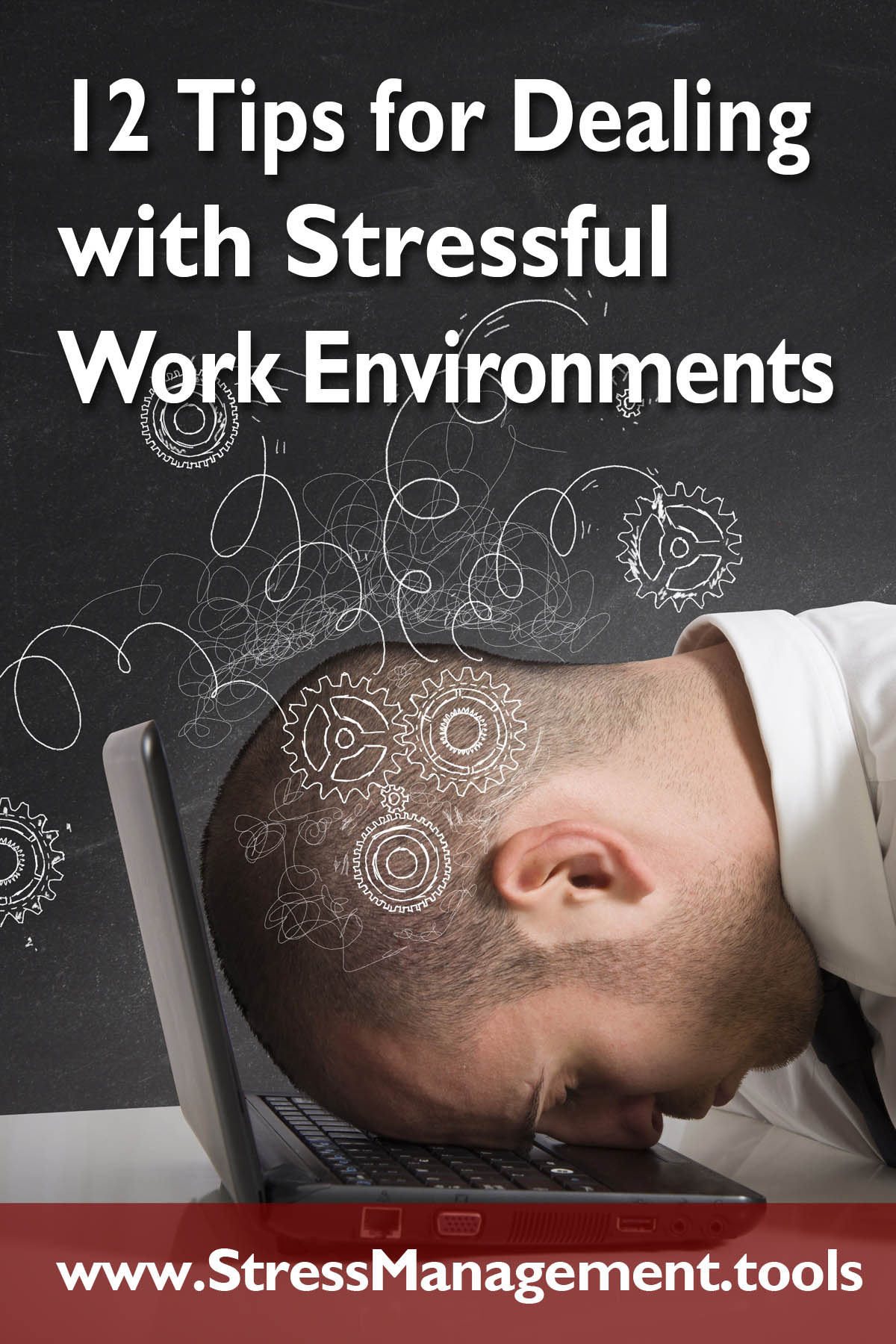
12 Tips for Dealing with Stressful Work Environments

December 17, 2023 by Martin Neumann - [rt_reading_time label="Reading Time:" postfix="minutes" postfix_singular="minute"]

12 Tips for Dealing with Stressful Work Environments

Do you dread getting out of bed every day to go to work because your work environment is too stressful? You are not alone. 75% of employees believe that workers have more on-the-job stress than a generation ago. 62% of US workers reported having high levels of stress, involving extreme fatigue or feeling out of control. And working women tend to report higher stress levels than men.((All statistics from: Workplace Stress. American Institute of Stress))

12 Tips for Dealing with Stressful Work Environments

For many it is not only the excessive workload that causes them stress, but also people issues and the work environment.  You may find that the people you work with are intolerable or that the setup of your workplace is simply not conducive to getting things done efficiently. Dealing with stressful work environments is something many of us have to face every day, but you don’t have to let it get you down.  Instead, by learning how to deal with your stress at work you’ll be able to boost your energy and reduce frustration.

How to Deal with Stressful Work Environments

Establish a stress-reducing morning routine. When you drown a coffee in the morning, rush your kids to school, and face the traffic madness on the way to work, probably you are already stressed before starting your work. Be sure you get up early enough to eat a substantial and healthy breakfast, do your household duties without stress, and ideally get some form of exercise, even if it is a few minutes walking around the block before you slip through the office door.

Create a daily to-do list. Many times, when we are stressed out, it’s because we are not clear on what needs to be done, and important tasks may even fall through the cracks so they need to be done under time pressure. This causes our stress levels to rise quickly and uncontrollably. When you create a to-do list, it won’t matter how hectic the office gets, you’ll have a list in front of you that’ll remind you what needs to get done for that day. You’ll feel more in control when you organize your day and you’ll be able to find some peace in the chaos surrounding you.

Be clear about your priorities. Having a to-do list is a good start, but having too many items on the list is often a source of stress. Figure out every morning what are the priorities that need to get done and focus on the most important task of this list. Don´t worry about the other items on the list, you are not supposed to finish it all in one day. If your supervisor defines your schedule, check in to figure out the priorities that are most important for the day. Being clear on the priorities makes you fret less about the secondary tasks.

To do list

Practice good time management. Efficiently manage your time by setting realistic deadlines and avoiding procrastination. If you are a perfectionist, you may fall for the temptation to spend too much time on a task to get it perfect and neglect some other things in the process that get undone for lack of time. Estimate how much time you want to spend on every task, and once the time is over, look at how you can wrap it up. Sometimes we underestimate the work involved and will need some extra time, but if you are tempted to spend your time in an endless routine of polishing your work, step back for a minute and remind yourself about the other tasks that need your attention, so you do not lose out on the big picture. Be sure to schedule your jobs well ahead of their deadlines, so you do not need to accomplish them under stressful time pressure.

Take short breaks. When we are under pressure, we often think that breaks are a luxury we cannot afford. We are trying to push through the day, but pretty soon stress is piling up until we are losing our minds. Actually, we will be much more productive when scheduling some regular 5-minute breaks in a 40 to 60 minute interval. Take just a moment to get up, walk around the block, watch the birds outside the window, or get a glass of water. Then you get back to work with new energy and a concentrated mind. Soon you will realize how you can handle your workload with ease.

Detach and recover after work. Work stress tends to pile up throughout the day, and long after we have left through the office door, the work challenges are still ruminating in our minds. We can break the cycle and engage in a recovery activity right after work. Listen attentively to music on your way home. Classical music will be especially effective since it involves you mentally. Get out into nature and actively observe your environment. Watch a squirrel finding a nut or a duck caring for her chicks. Engage in a hobby when coming home, and as paradox as it seems, the more engaging and demanding the free time activity you choose, the better you can recuperate from work stress. And resist the temptation to take work home or to answer work emails in the after-hours.

Avoid distractions and multitasking. Sometimes we think the more projects we handle at the same time, the more we will get done. Actually, exactly the opposite is true. Trying to divide the attention between two tasks is a surefire recipe for becoming inefficient. Our minds are simply not made to process two things at the same time. For maximum performance, we need to concentrate on the task at hand. Get your to-do list and determine the most important task to tackle first. Then you do not touch anything else until the task is done. Be sure to switch off your cell phone and the “You´ve got mail” alerts. Let your co-workers know that you need some distraction-free time. As soon as you have got your focus on the job, go for it with all your attention.

Establish healthy boundaries. If you are known for taking on the challenges of everybody else in the company, it is a surefire way to get burnout. People get lazy if they know there is somebody else to resolve what they did not manage to do. Avoid overcommitting to other people’s projects, when you have already too much on your plate for yourself. Be very clear in communicating your boundaries and limitations. If you have planned a weekend outing with your family, make it clear that you are not available to work overtime. Everybody needs to carry a fair share of their workload and responsibilities for themselves.

Create a space conducive to concentration. If your office is open-concept, you may find the hustle and bustle around you to be distracting. If this is the case, try setting up your workspace so that everything you need is right in front of you, so you don’t have to continually get up to grab stuff.  Also, try putting up a privacy screen (if possible), or rearranging your furniture or computer screen to create a barrier of sorts between you and the rest of the office.

An office space with drawer placed to produce privacy

Be proactive in your communication. It is very tempting to assume that everybody else knows what is in your head and is on the same page with you. But in reality, misunderstandings happen frequently because of poor communication. Be sure to frequently align your priorities with your colleagues and supervisors. Assure that everybody is pulling in the same direction. When problems arise, be sure to express your thoughts calmly and assertively. Avoid bottling up emotions until you explode. And always be open for constructive feedback without going into defense mode.

Learn to delegate. It is tempting to think that you are always the best person to get the job done and there is nobody else to replace you. Continue to think like that for a while until you are burned out and have to delegate your work to somebody else. More often than we think somebody else can do your work just as well and you can give your colleagues a chance to develop new skills. Once you have delegated something, do not go back to fuss around with the work you have passed on to somebody else. Accept that your colleague may do things slightly differently. Focus on the tasks that you do best and that really will turn the ship around, but let others handle some of your nitty gritty stuff that is easy to resolve.

Move around within the company or find a better fit elsewhere.  Many people simply cannot overcome the stressful environment in which they work.  Besides, no one should work in a situation where they always feel on edge!  If you have a job that is too demanding or rarely allows you to tend to your personal life, then it may be time to find a better fit. The same is true if you feel yourself at the wrong place. Nothing is more stressful than doing something all day long that you do not like. Getting a new job can be stressful in itself, but when you find something that is right for you, you’ll notice the old way of stressful living will dissipate and you’ll be left with a happier, healthier, and more peaceful life.

Workplace stress is at an all-time high, but in many cases, you’ll be able to overcome this stress using the workplace stress tips mentioned above. If the work environment becomes too stressful and toxic to deal with, you’ll want to take action.  After all, you must put yourself first if prolonged and unmanaged stress becomes destructive to your body and mind.

Do you need a guide to help you understand how to cope with Stress in an all inclusive approach? Learn how to combat stress, mentally, physically, emotionally and strategically in your life.

Get Me the Guide

Filed Under: Mental Health, Stress Management Tagged With: work stress

Four Habits That Can Reduce Your Stress Levels

November 19, 2023 by Martin Neumann - [rt_reading_time label="Reading Time:" postfix="minutes" postfix_singular="minute"]

4 Habits That Can Reduce Your Stress Levels

We all have habits. Some of those habits are more helpful for us than others. What if yours could help you to control your stress?

4 Habits That Can Reduce Your Stress Levels

We are all exposed to stress. It becomes problematic if we are facing high levels of chronic stress. Some of us face more stress than others. For instance, if you’re in a particularly challenging job, or you’re struggling with your relationship, you might find that your stress levels are overly high.

The good news? There are simple things you can do to reduce your stress levels!

Here are 4 simple stress-reducing habits to develop:

Journaling

Journaling is an often-underestimated practice. Writing down your thoughts and feelings helps you to organize them more effectively. This can also help with processing complex ideas or coming up with creative solutions for your challenges.

  • There are tons of ways to get started with journaling. Some people simply grab a notepad and a pen and get to it. Others prefer using journaling apps that come with prompts to guide them. It’s all about finding what works for you.
  • You can use many different styles. Some like to write in the format of a letter to themselves or someone they have issues with. That can help to let go of traumatic events of the past. You can also write down some keywords or abstract thoughts. Choose any format that works for you.
  • If you don’t want to waste paper, or simply prefer typing, don’t worry. You can create your journal just as well on your computer.
A woman sitting in a lawn writing a journal

Exercise

If you’re constantly facing high levels of stress, you might think you don’t have time to exercise. After long days at work or tough days looking after the kids, sometimes all you want to do is sit down and relax.

  • While there’s nothing wrong with taking a break, it does help to get more physical activity into your schedule whenever you can. Making a regular dose of exercise part of your daily schedule could make a huge impact on your life.
  • You could do something simple, like walking the dog or taking a bike ride. Or you could look into joining health classes and learning how to do something new. There are even classes you can take online these days.
  • Exercise is great for boosting endorphins, strengthening self-esteem, and protecting you against a range of ailments.
  • Try to get in an exercise block close to your stressor. If you had a stressful phone call, get up and run three times around the block. Get a walk just before going to work if you expect some stressful events to happen that day.
A couple walking at the beach

Enjoy some music

Here’s a hobby we can probably all get behind. Who doesn’t love music?

  • Music is capable of influencing our mood. It can make us feel motivated or relaxed. Therapists and medical professionals often recommend listening to music for its health-enhancing properties.
  • Music can be a fantastic way to relieve stress, physically and emotionally, and it can even reduce your stress perception, by allowing you to relax more completely.
  • There are tons of ways to add a little music to your day. You can play your favorite songs on your commute to work or just play some music in the background when you’re cooking in the kitchen.
  • Choose wisely the music you use at every occasion. Different music styles can produce different effects on the body. Choose a music that will fit the occasion and is aligned with your personal taste. It will help you to reduce your stress levels and give a boost to your mood.
A woman with headphones listening to relaxing music

Socialize

Finally, it’s worth remembering from time to time that human beings are social creatures. When we’re feeling sad, stressed, or less than our best, it’s common to want to isolate. However, the best thing you can usually do during these difficult times is to connect with others.

  • You don’t need to be face-to-face to feel the benefits. Whenever possible you can give a friend or family member a call or video chat with them.
  • If you do happen to have access to someone nearby that you love, arrange to have a cup of tea with them or just give them a hug the next time you’re nearby.
  • Remembering that you’re not in this alone is great for your mood, and socializing can significantly strengthen your confidence too.

Instilling these enjoyable habits into your daily routines will have a positive impact on your life, while greatly reducing your stress levels. Try it! You’ll like it!

Do you need a guide to help you understand how to cope with Stress in an all inclusive approach? Learn how to combat stress, mentally, physically, emotionally and strategically in your life.

Get Me the Guide

Filed Under: Mental Health, Stress Management Tagged With: exercise, journaling, music, socializing

An Effective Process to Deal with a Financial Crisis

October 22, 2023 by Martin Neumann - [rt_reading_time label="Reading Time:" postfix="minutes" postfix_singular="minute"]

Dealing with Financial Crisis

Financial Stress can cause you sleepless nights and can be devastating. For dealing with that you need to have a good plan.

An Effective Process to Deal with a Financial Crisis

There are varying degrees of financial stress. For example, consider the stress levels in these statements:

  • “How will we pay for the vacation in Hawaii this year?”
  • “We don’t have enough money to go eat out in the restaurant, but we can have Pizza Palace deliver.”
  • “We can pay the electric bill or the gas bill, but we can’t pay both. Remember that the bank said we’d lose the car if we don’t make a payment by the 10th of the month.”

Some people are fortunate enough to have never been in the last situation, but many people aren’t so lucky. Desperate times are highly stressful times.

The good news is that it is possible to get out of a financial crisis! Alleviating such financial pressure requires a cool head and a plan.

Follow this process to reduce your financial stress and see brighter days ahead:

Gather information

Get an accurate picture about your situation. It’s easy to make yourself more upset than necessary. Ensure that you have a factual representation of what’s going on.

  • How much money are you making?
  • What are your bills?
  • How much debt do you have?
  • What resources are available to you?

Focus on solutions

If you focus on the problem, your mind is easily getting stuck in negative self-pity. You will find it hard to see a light at the end of the tunnel if you focus on the wrong thing. Commit yourself to finding solutions.  Most of us tend to focus on comfort, which is a big mistake. Nothing happens when you make yourself comfortable. You’re just distracted. Spend the vast majority of your time looking for and working on solutions.

  • You can take it easy at night before bed and focus on making yourself comfortable then to help you have a good night’s sleep.

Eliminate every unnecessary expense

Most people have several expenses that provide little to no value. Do you have a gym membership you never use? Magazine subscriptions? Expensive cell phone plan?

  • Get rid of every expense you don’t truly need. Of course, you must pay for your housing, utilities, food, medicine, and insurance. However, everything else is optional.

Determine what you can and cannot influence

Most of us worry about things we can’t control. There’s actually very little you can control. You can control your thoughts, attitude, and actions. And if you can’t do anything about it, then just accept that it is out of your hands.

  • Focus on what you can influence and avoid worrying about the rest.

Determine how every penny is being spent

When you’re under serious financial stress, it’s important to know where all of your money leaks are occurring. Discover where every cent is going each month. Track it all.

Doing accounting of the expenses

Work on a plan to boost your income

If you had enough money, your financial stress would go away. There’s always a way to make more money if you’re committed to providing more value to the world.

  • You might want to get a second job or a side hustle. It might be time to start an online business or to look for a better-paying job.

Budget

Do you have a budget? Most people don’t. Choose where your money is going before you spend it. Make a spending plan and stick to it.

Find ways to relax

The solution to stress is to either remove the source of the stress or to relax. Plan relaxation time into your schedule each day. If you’re too stressed for too long, you’re likely to end up sick. Too much stress reduces your ability to function optimally.

  • Experiment with various relaxation methods to find out what works best for you. Some healthy options include listening to your favorite music, taking a warm bath, engaging in a hobby that pleases you, playing with your kids or pets, going for a walk, or hiking on a nature trail.

Ask for help

It might be time to ask for help. Friends, family, your employer, your banker, or even your creditors can all be of help during financial challenges.

Financial stress is a leading cause of divorce, suicide, and many health issues. Financial issues can be an overwhelming challenge. Ensure that you’re working with accurate information, scaling back, boosting your income, and making a plan. Ask for help if you need it. There is a way out, although it might be challenging. Never give up!

Do you need a guide to help you understand how to cope with Stress in an all inclusive approach? Learn how to combat stress, mentally, physically, emotionally and strategically in your life.

Get Me the Guide

Filed Under: Mental Health, Stress Management Tagged With: financial crisis

5 Teas That Reduce Stress and Support Sleep

September 24, 2023 by Martin Neumann - [rt_reading_time label="Reading Time:" postfix="minutes" postfix_singular="minute"]

Teas for stress control

Stress is called the silent killer for a reason. From panic attacks to trouble sleeping, a dose of stress can do a number of things with your health. Yet most of us are so used to keep up with the hamster wheel of chronic stress that we tend to ignore the issue until it’s too late.

5 Teas That Reduce Stress and Support Sleep

Excessive stress will quickly be felt on our quality of sleep, which in turn will increase our stress hormones. So implementing some calming teas into our night time routine can do wonders to control our stress. Not only do these teas promote relaxation, but they may help the estimated 30% of the population who suffer from chronic sleeplessness and insomnia too.((Roth T. Insomnia: definition, prevalence, etiology, and consequences. J Clin Sleep Med. 2007 Aug 15;3(5 Suppl):S7-10. PMID: 17824495))

Consider enjoying a cup of one of these teas each day:

1. Chamomile Tea. Probably the best-known choice for relaxation, chamomile tea is an ancient remedy for inflammation, anxiety, and insomnia. Some experts say that the effects of chamomile are similar to that of a mild tranquilizer.

  • Chamomile is packed full of a substance called apigenin, which helps to decrease anxiety and initiate sleep. Studies have found that drinking around 400mg of chamomile extract a day can improve sleep quality.((Adib-Hajbaghery M, Mousavi SN. The effects of chamomile extract on sleep quality among elderly people: A clinical trial. Complement Ther Med. 2017 Dec;35:109-114. doi: 10.1016/j.ctim.2017.09.010.))
  • Further research has also gone on to show that postpartum women suffering from poor sleep quality were soothed with chamomile tea.
  • While not everyone will respond well to chamomile, the gentle taste and relaxing aroma are a great place to start if you suffer from stress.
Chamomile flowers

2. Valerian Tea. The valerian herb is another substance that has appeared throughout the centuries as a cure for nervousness and insomnia. The product was also used in England during World War II as a way to relieve stress caused by air raids.((Valerian. Fact Sheet for Health Professionals. National Institutes of Health))

  • Valerian is one of the most popular sleep aids in the world today, and it’s available in both liquid and capsule form, as well as a tea. Researchers believe that valerian root may improve GABA levels in the body, which can improve sleepiness, and reduce anxiety.((Dorn M. Wirksamkeit und Verträglichkeit von Baldrian versus Oxazepam bei nichtorganischen und nichtpsychiatrischen Insomnien: Eine randomisierte, doppelblinde, klinische Vergleichsstudie [Efficacy and tolerability of Baldrian versus oxazepam in non-organic and non-psychiatric insomniacs: a randomised, double-blind, clinical, comparative study]. Forsch Komplementarmed Klass Naturheilkd. 2000 Apr;7(2):79-84. German. doi: 10.1159/000021314.))
  • Studies into valerian root for insomnia indicate that it can reduce the amount of time it takes for a person to fall asleep at night and improve the quality of the sleep too. These studies also indicate minimal side effects after using valerian. There are no issues such as morning drowsiness to detract from the experience.((Leathwood PD, Chauffard F, Heck E, Munoz-Box R. Aqueous extract of valerian root (Valeriana officinalis L.) improves sleep quality in man. Pharmacol Biochem Behav. 1982 Jul;17(1):65-71. doi: 10.1016/0091-3057(82)90264-7.))
A girl smelling a valerian flower

3. Lavender. There are few things more relaxing than the smell of lavender. This sweet and soothing herb is championed for its ability to reduce stress and improve sleep quality. The substance is available in tea form as a way of encouraging relaxation and stronger sleeping patterns.

  • According to one study, women who drank and enjoyed the aroma of lavender tea for two weeks had less fatigue than their counterparts.((Chen SL, Chen CH. Effects of Lavender Tea on Fatigue, Depression, and Maternal-Infant Attachment in Sleep-Disturbed Postnatal Women. Worldviews Evid Based Nurs. 2015 Dec;12(6):370-9. doi: 10.1111/wvn.12122.))
  • Other studies indicate that reductions in heart rate and heart rate variability were evident in women who inhaled the scent of lavender for 12 weeks, twice per week.((Chien LW, Cheng SL, Liu CF. The effect of lavender aromatherapy on autonomic nervous system in midlife women with insomnia. Evid Based Complement Alternat Med. 2012;2012:740813. doi: 10.1155/2012/740813.))
  • Try sweetening this tea with honey for a unique sleeping experience.
Lavender

4. Lemon Balm. Lemon balm is an herb that actually comes from the mint family. It is great for reducing stress and improving relaxation. Evidence suggests that lemon balm could be effective at increasing GABA levels, which improve sleepiness.

  • Further studies show up to a 42% reduction in symptoms of insomnia after patients took a lemon balm extract for 15 days.((Cases J, Ibarra A, Feuillère N, Roller M, Sukkar SG. Pilot trial of Melissa officinalis L. leaf extract in the treatment of volunteers suffering from mild-to-moderate anxiety disorders and sleep disturbances. Med J Nutrition Metab. 2011 Dec;4(3):211-218. doi: 10.1007/s12349-010-0045-4.))
  • The warm and refreshing lemon balm tea could be an incredible benefit to your night-time routine, and the flavor will likely appeal to plenty of people.
Lemon Balm

5. Passionflower. Made from the dried stems, flowers, and leaves of the Passiflora plant, passionflower tea is a traditional solution to feelings of anxiety and insomnia. Studies indicate that this substance may be suitable for improving sleep quality and insomnia.((La Forge T. Drink A Cup of Passionflower Tea Every Night for Better Sleep. Healthline, May 31, 2019))

  • A study among 40 adults found that those drinking passionflower tea for one week reported a significantly better quality of sleep than their counterparts.((Ngan A, Conduit R. A double-blind, placebo-controlled investigation of the effects of Passiflora incarnata (passionflower) herbal tea on subjective sleep quality. Phytother Res. 2011 Aug;25(8):1153-9. doi: 10.1002/ptr.3400.))
  • Further studies have shown that a combination of passionflower and other relaxing substances like valerian root can be excellent for treating insomnia.
Passionflower

Sip Your Way to Sleep

Many delightful herbal teas are now making their way into the market as powerful sleep aids. Although these teas won’t eliminate the underlying cause of your sleeping or stress issues, they can help you to get the relaxation you need.

For those suffering from high levels of anxiety and stress, the teas above offer a natural solution to common issues like insomnia. However, if you are using these teas for sleep improvement, try to avoid using any sweeteners, as these could increase your blood sugar levels and make you feel more awake.

For a natural and pleasant alternative to pharmaceuticals, consider trying these teas to help relieve stress and support a great night of sleep that refreshes you.

Do you need a guide to help you understand how to cope with Stress in an all inclusive approach? Learn how to combat stress, mentally, physically, emotionally and strategically in your life.

Get Me the Guide

Filed Under: Herbs, Mental Health, Stress Management, Therapies

Next Page »

Primary Sidebar

Social Channels

Coronavirus Immunity Challenge

Boost your immune system to be bullet-proof for the pandemic.

I Want to Participate

Recent Posts

  • 5 Habits to Live Longer
  • Better Sleep Can Protect Against Dementia
  • Finding Peace In Your Crazy-Busy World
  • Flaxseed – An Ancient Plant Rediscovered
  • Platelets – Triggers for Life or Death
  • Boderline Personality Disorder
  • In Praise of Almonds and Nuts
  • Are You Stuck in the Clutter Trap?

Categories

  • Body Systems (16)
    • Cell Function (2)
    • Circulatory System (1)
    • Digestive Tract (10)
    • Immune System (4)
  • Diseases (27)
    • Cancer (2)
    • Cold (1)
    • COVID-19 (11)
    • Dementia (1)
    • Diabetes (1)
    • Digestive Diseases (2)
    • Heart Disease (2)
    • Kidneys (1)
    • Metabolic Syndrome (2)
    • Skin (1)
  • Healthy Lifestyle (42)
    • Exercise (11)
    • Gardening (2)
    • Sleep (7)
    • Sunlight (2)
    • Temperance (14)
    • Water (4)
  • Mental Health (87)
    • Addictions (6)
    • Anxiety (7)
    • Burnout (1)
    • Depression (7)
    • Psychosomatic Diseases (6)
    • Stress Management (45)
    • Trust (6)
  • Nutrition (56)
  • Obesity (9)
  • Phases of Life (14)
    • Adults (3)
    • Babies and Infants (1)
    • Children (3)
    • Seniors (5)
    • Teenagers (3)
  • Therapies (7)
    • Herbs (5)
    • Hydrotherapy (1)
  • Uncategorized (3)

Archives

  • January 2025 (1)
  • March 2024 (5)
  • February 2024 (4)
  • January 2024 (4)
  • December 2023 (5)
  • November 2023 (4)
  • October 2023 (5)
  • September 2023 (4)
  • August 2023 (3)
  • July 2023 (2)
  • June 2023 (4)
  • May 2023 (4)
  • April 2023 (5)
  • March 2023 (4)
  • February 2023 (4)
  • January 2023 (4)
  • December 2022 (4)
  • November 2022 (4)
  • October 2022 (5)
  • September 2022 (4)
  • August 2022 (4)
  • July 2022 (5)
  • June 2022 (4)
  • May 2022 (5)
  • April 2022 (4)
  • March 2022 (4)
  • February 2022 (4)
  • January 2022 (5)
  • December 2021 (3)
  • November 2021 (4)
  • October 2021 (6)
  • September 2021 (4)
  • August 2021 (4)
  • July 2021 (5)
  • June 2021 (4)
  • May 2021 (3)
  • April 2021 (5)
  • March 2021 (4)
  • February 2021 (4)
  • January 2021 (5)
  • December 2020 (3)
  • November 2020 (4)
  • October 2020 (5)
  • September 2020 (5)
  • August 2020 (3)
  • July 2020 (1)
  • June 2020 (1)
  • May 2020 (1)
  • April 2020 (1)
  • March 2020 (1)

Copyright © 2026 · Abundant Health - Privacy Policy - Medical Disclaimer